Metal Craft
Aranmula Kannadi and the Bell Metal Craft of Kerala
Also known as Aranmula Kannadi, Nachiarkoil Kuthuvilakku
The story
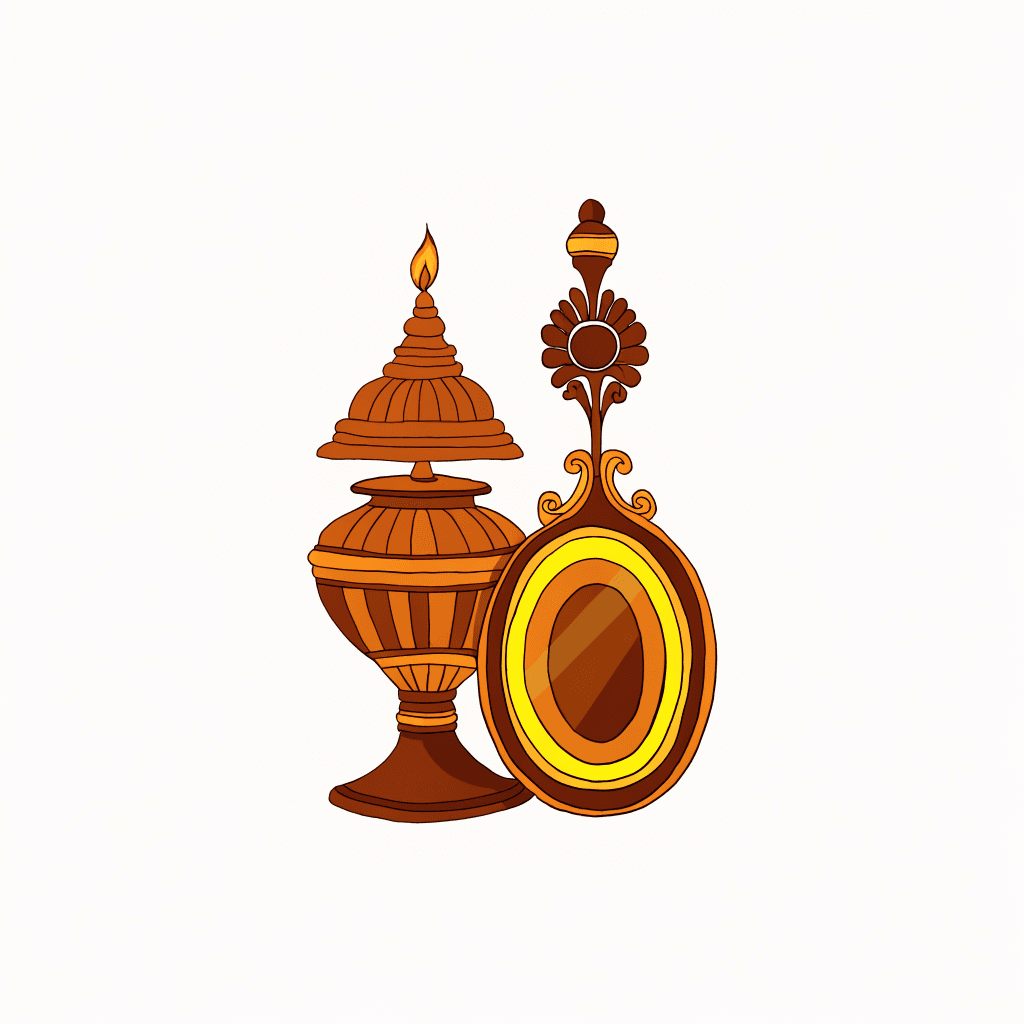
Bell metal — bronze rich in tin — is the sacred alloy of South Indian temple life, cast for centuries into lamps, bells, urulis and ritual vessels by hereditary smith communities: the Moosari and wider Vishwakarma groups of Kerala, and their counterparts across Tamil Nadu. The tradition's most celebrated object is the Aranmula Kannadi, made in the village of Aranmula on the Pamba river in Kerala: a mirror of metal, not glass. Its casters polish a secret copper-tin alloy to such a finish that it reflects from its front surface, without the faint doubling a glass mirror's rear coating produces. The formula is guarded within a handful of families, passed down as living inheritance, and the mirror itself is counted among the ashtamangalyam — the eight auspicious objects of Kerala ritual. The related lamp traditions run just as deep: the tiered kuthuvilakku and ceremonial deepams cast at centres like Nachiarkoil in Tamil Nadu light temples and homes across the South. Together these crafts preserve a temple-grade metallurgy — precise alloying, clay and sand moulding, long hand-polishing — that has changed remarkably little, because its patrons, the temples and the ritual calendar of the South, have never gone away.
How it is made
Bell-metal work begins with the alloy: copper melted with a high proportion of tin, which makes the metal harder, finer-grained and more sonorous than common bronze. Lamps and vessels are cast in clay or sand moulds, then turned, scraped and polished. The Aranmula Kannadi is the extreme case. Its makers cast a thin blank of their secret high-tin alloy in a clay mould, then grind and polish the face by hand for days — traditionally with cloth and fine powders — until the metal itself becomes the reflecting surface. No glass or silvering is involved: the image forms on the front of the metal, which is why it shows no secondary reflection. The finished mirror is set into a cast brass frame with a handle or stand.
Buying guide
Test a Kannadi the traditional way: touch a fingertip to the surface. On a front-surface metal mirror the reflection meets your finger with no gap; on glass there is a visible offset from the backing layer. Expect modest sizes — large Kannadis are rare and expensive. Bell-metal lamps should ring clearly when tapped and feel dense for their size. Small lamps and mirrors typically start around ₹1,500–4,000; large kuthuvilakkus and presentation-grade Kannadis can reach ₹80,000.
Care
Never wet-clean an Aranmula Kannadi — wipe it only with a soft, dry cloth, and keep fingers off the polished face; scratches cannot be repaired outside the maker's workshop. Bell-metal lamps tolerate more handling: wash after oil use, dry fully, and brighten occasionally with tamarind paste rinsed off promptly — a traditional and gentle method.
Good questions, honest answers
How is an Aranmula Kannadi different from a normal mirror?
An ordinary mirror is glass silvered on the back, so light passes through the glass before reflecting — producing a slight double image. The Aranmula Kannadi reflects from the polished front surface of the metal itself. There is no glass and no backing layer, so the reflection is single and true, which is part of the mirror's ritual and optical prestige.
Why is the Kannadi's alloy formula secret?
The exact copper-tin proportions and finishing method are hereditary knowledge, held by a small number of Aranmula families and never published. The secrecy is itself traditional — the formula is treated as the community's inheritance and livelihood. It is also why genuine Kannadis come only from Aranmula, a link now formalised by the craft's Geographical Indication.
What exactly is bell metal?
Bell metal is bronze with an unusually high tin content — the alloy used for bells because it is hard, fine-grained and resonant. In Kerala and Tamil Nadu it is the preferred metal for ritual objects: lamps, urulis, cymbals and temple vessels. A clear ring when tapped is the classic sign of a good bell-metal casting.
Explore the living traditions
We are onboarding Aranmula & Kerala Bell Metal artisans. Meanwhile, explore every craft available on VedikCraft today.
Explore all crafts →
At a glance
- Regions
- Aranmula, Kerala · Tamil Nadu
- Community
- Vishwakarma / Moosari
- Materials
- bell-metal, bronze
- Techniques
- casting, polishing
- Typical price band
- ₹1,500 – ₹80,000