Paintings & Folk Art
Madhubani Painting — Line, Fill and Ritual in Mithila
Also known as Mithila painting
The story
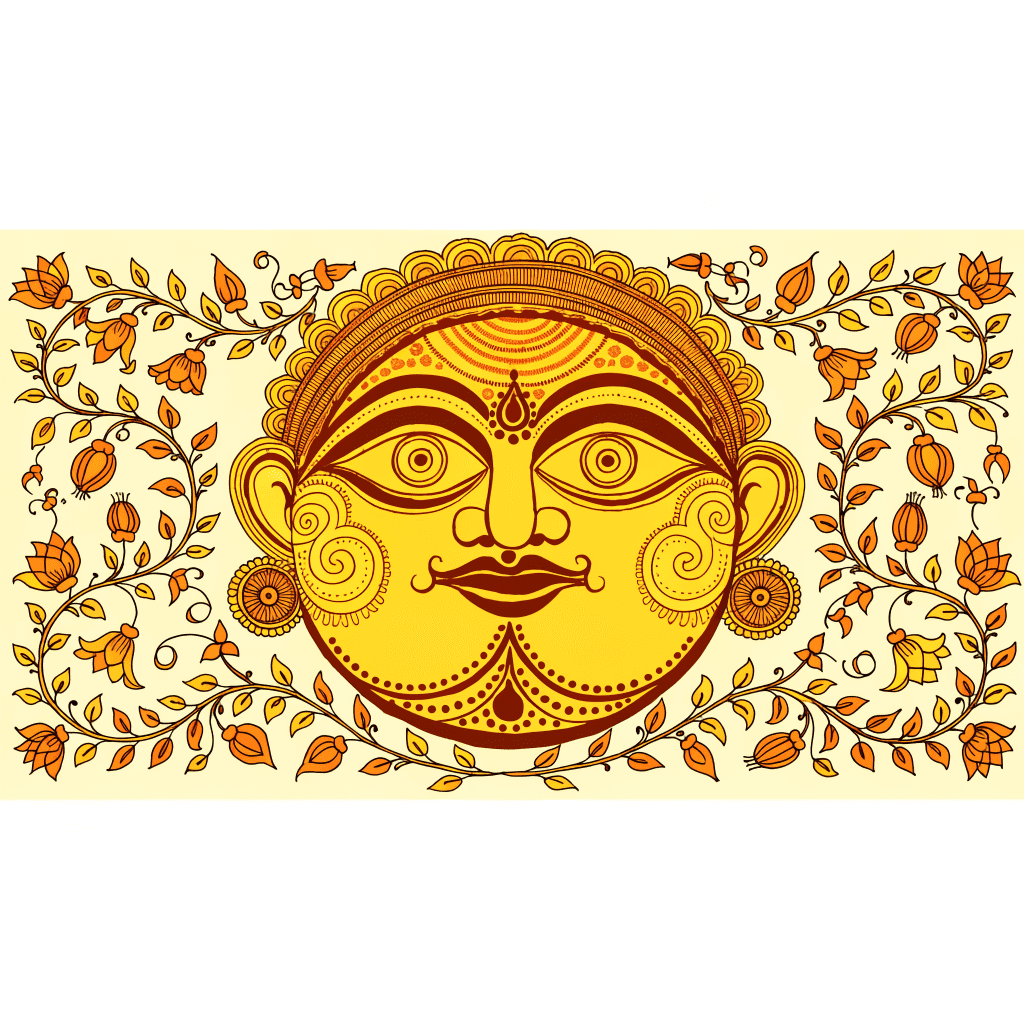
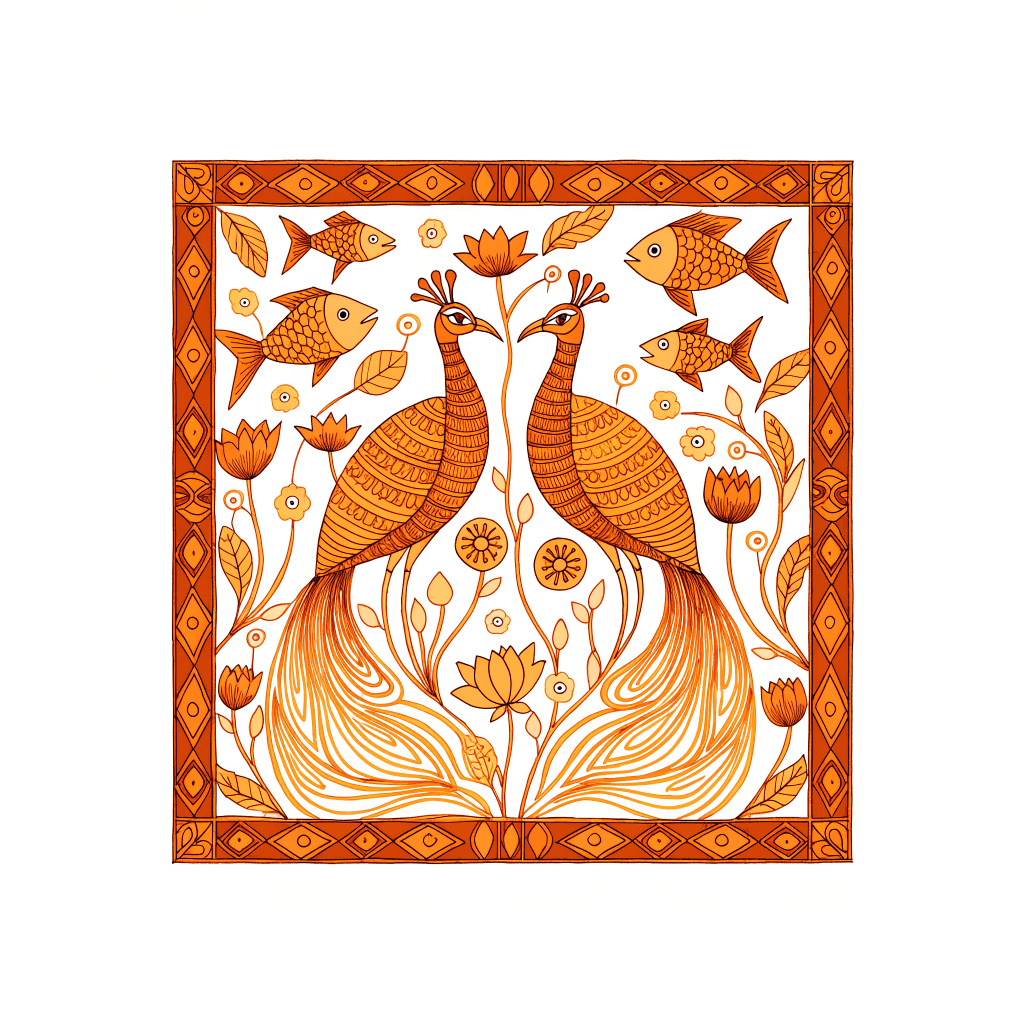
Madhubani painting — also called Mithila painting after its home region in northern Bihar — began not on canvas but on walls. For generations, the women of Mithila painted the mud walls and floors of their homes for weddings, festivals and rites of passage, covering the kohbar ghar, the nuptial chamber, with dense symbolic compositions: lotus and bamboo, fish and parrots in pairs, the sun and moon, Durga, Krishna and Shiva. The paintings were ritual acts as much as decoration, invoking fertility and blessing, and the vocabulary passed from mother to daughter as household knowledge. The outside world took notice in the twentieth century — colonial officials documented the wall art after the great 1934 Bihar earthquake cracked open homes — and when drought struck Mithila in the 1960s, craft agencies encouraged the women to transfer their walls to handmade paper so the paintings could be sold. That move turned a domestic ritual into a livelihood and carried Madhubani to galleries worldwide. Distinct styles flowered — the colour-saturated bharni, the line-built kachni, the tattoo-derived godna of Dusadh community painters — and the tradition, once anonymous, has produced nationally honoured artists. It remains one of the world's great living folk-art traditions, still overwhelmingly in women's hands.
How it is made
A Madhubani painting is built from line. On handmade paper or canvas, sometimes primed with a wash for a toned ground, the artist draws the composition directly — traditionally with bamboo twigs and fingers, today often with nib pens and fine brushes. The signature double-line border frames the work, and every interior space is filled: no ground is left empty, its gaps packed with fish, birds, flowers and geometric fill-work. Colours were traditionally ground from nature — lampblack, turmeric yellow, indigo, reds from local flowers and minerals, greens from leaves — bound with gum; many painters still prepare natural pigments, while others use ready colours. In kachni work, shading is achieved purely through hatched and layered lines rather than solid colour.
Buying guide
An authentic piece is hand-drawn: look for the slight tremor and varying ink weight of freehand line, visible pigment texture, and fill-work that never quite repeats — prints show dot patterns under magnification and perfect uniformity. Handmade paper has a soft, fibrous edge. Genuine work usually carries the artist's signature, often with the village. Small paintings typically start around ₹800–2,000; large, intricate works by senior artists can command ₹60,000.
Care
Frame under glass with acid-free mounting, and hang away from direct sunlight — natural pigments are beautiful but light-sensitive, and turmeric yellows fade fastest. Keep the painting out of humid rooms to protect the handmade paper. Never wipe the painted surface; dust the frame only, and store unframed works flat between acid-free sheets.
Good questions, honest answers
What do the fish, peacocks and lotus motifs mean?
The motifs are a ritual vocabulary. Fish signify fertility and good fortune, parrots in pairs stand for love and union, the lotus for purity and the feminine, bamboo for lineage and progeny, and the sun and moon for cosmic blessing. On kohbar compositions — made for the wedding chamber — these symbols are arranged specifically to bless a new marriage.
What is the difference between bharni, kachni and godna styles?
Bharni means 'filling' — bold figures saturated with flat colour. Kachni means 'line' — compositions built almost entirely from fine hatched linework with minimal colour. Godna derives from tattoo patterns and features rows of small repeated figures and geometric motifs; it was developed by painters of the Dusadh community. Many artists now move fluently between the styles.
Are Madhubani paintings still made with natural colours?
Many painters still grind traditional pigments — lampblack from soot, yellow from turmeric, blue from indigo, reds and greens from flowers, minerals and leaves — bound with gum. Others work with ready-made poster or acrylic colours, especially for larger orders. If natural pigment matters to you, ask the seller; genuine natural-colour work has a softer, more variable tone.
Bring Madhubani / Mithila home
Authentic Madhubani / Mithila pieces, artisan-direct with provenance on every listing.
Shop authentic Madhubani →
At a glance
- Region
- Mithila, Bihar
- Community
- Mithila women painters
- Materials
- handmade-paper, canvas, natural-pigment
- Techniques
- line-work, fill-work, double-line border
- Typical price band
- ₹800 – ₹60,000