Paintings & Folk Art
Kangra Painting: The Pahari Miniature Tradition
Also known as Pahari miniature
The story
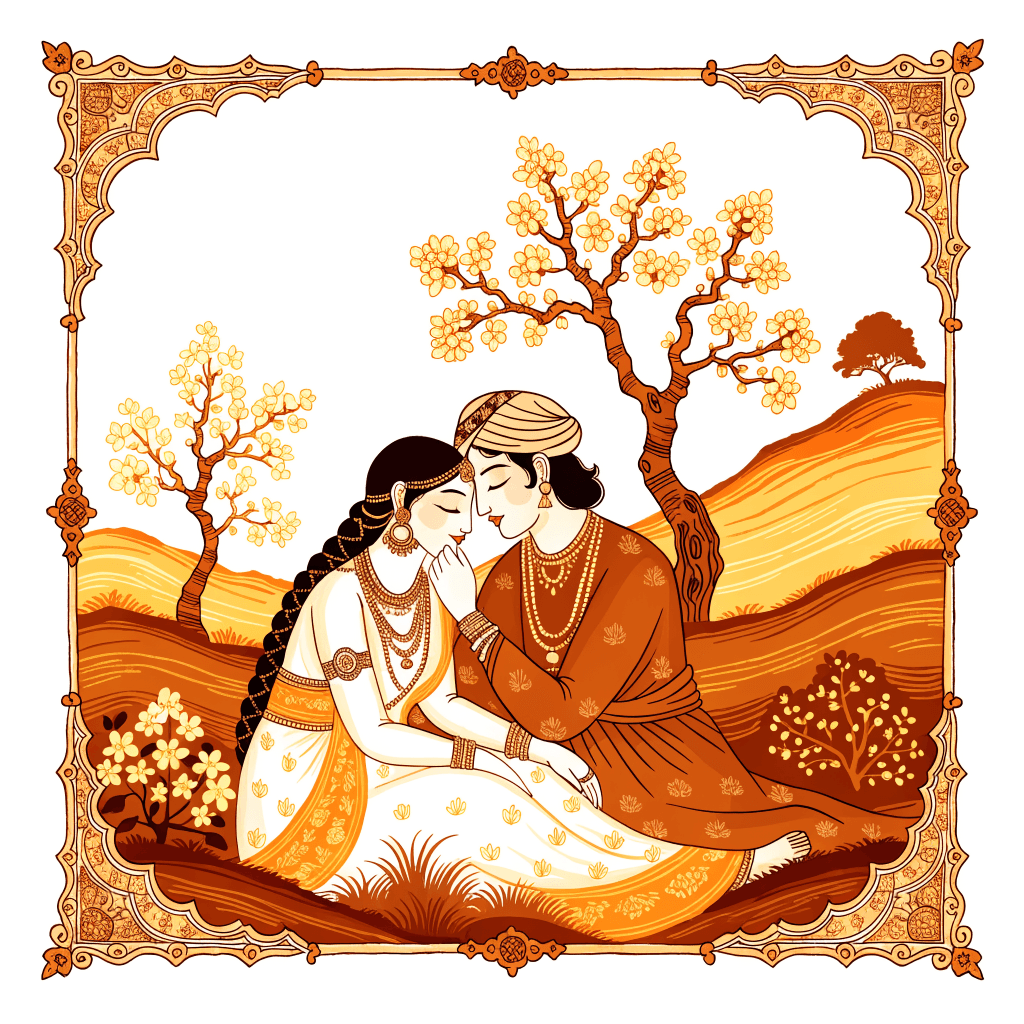
Kangra painting is the most celebrated of the Pahari miniature schools that flowered in the Himalayan foothill courts of North India. The style took shape in the eighteenth century, when painters trained in the Mughal-inflected idiom of neighbouring Guler found patronage in the Kangra valley, and it reached its lyrical peak under Raja Sansar Chand, the school's great patron. Where Mughal painting recorded the court, Kangra painted feeling: its beloved subjects are Radha and Krishna from Jayadeva's Gita Govinda, episodes from the Bhagavata Purana, Baramasa verses on the twelve months, and Ragamala series that give musical modes human form. Figures are drawn with a soft, unbroken line, heroines are rendered with famous delicacy, and every romance unfolds against real Himalayan scenery — misty ridges, flowering trees, monsoon skies, rivers in spate. Royal patronage faded through the nineteenth century, but families of Kangra painters carried the techniques forward, and workshops in and around Kangra still train new hands in the old discipline. Today the school is counted among India's great classical painting traditions, held by museums worldwide and protected by a registered Geographical Indication that ties the name to its home valley.
How it is made
A Kangra miniature begins with handmade paper, layered and burnished with a smooth stone until it takes the finest line. The painter sketches lightly, then lays in colour with pigments ground by hand — minerals and earths for the strong notes, vegetable colours for the tender ones — bound in gum. Brushes are exceptionally fine, traditionally of squirrel hair, and the signature Kangra contour is drawn in a single confident pass. Faces, jewellery and textiles are built up in thin washes, and the sheet is burnished again from the back so the surface develops a soft sheen. Pure gold is reserved for ornaments, halos and borders, applied sparingly and polished to a warm glow. A detailed work can hold a painter for weeks, sometimes months.
Buying guide
A genuine Kangra miniature is painted, not printed. Under a loupe you should see individual brush strokes, small shifts in line weight, and gold that sits very slightly raised; a print is uniformly flat and resolves into dots. Handmade paper with a soft, burnished surface is another good sign. Prices track fineness and size: small studies typically start around ₹2,000, accomplished works run into the tens of thousands, and museum-grade pieces can exceed ₹1,00,000. Ask for the painter's region and GI-tagged provenance where offered.
Care
Treat a Kangra painting as the delicate work on paper it is. Frame it behind glass — UV-filtering if possible — with an acid-free mount, and hang it away from direct sunlight and damp walls. Never touch the painted surface; natural pigment and gold can lift. Dust the frame rather than the art, and avoid kitchens, bathrooms and exterior walls where humidity swings.
Good questions, honest answers
How do I tell a hand-painted Kangra miniature from a print?
Look closely, ideally with a magnifying glass. Hand-painted work shows individual brush strokes, tiny variations in line weight, and gold that sits slightly proud of the surface; prints are flat and break into regular dots under magnification. Handmade paper with a burnished, faintly uneven texture is another reliable sign, as is a clear attribution to a painter or workshop in the Kangra region.
What subjects are traditional in Kangra painting?
The heart of the school is Krishna and Radha, painted from Jayadeva's Gita Govinda and the Bhagavata Purana. Alongside these come Baramasa series depicting the twelve months, Ragamala paintings that personify musical modes, and studies of heroines in love. Landscape is never an afterthought — the hills, rivers and flowering trees of the Kangra valley are part of the story.
Do Kangra painters still use natural pigments?
Many do. Traditional practice grinds minerals and earths by hand, binds them in gum, and details with pure gold — and works made this way are prized and priced accordingly. Some contemporary painters use modern watercolours for affordable pieces. If it matters to you, ask; a good seller will state the materials plainly.
Explore the living traditions
We are onboarding Kangra Painting artisans. Meanwhile, explore every craft available on VedikCraft today.
Explore all crafts →
At a glance
- Region
- Kangra, Himachal Pradesh
- Community
- Kangra painters
- Materials
- handmade-paper, natural-pigment, gold
- Techniques
- Pahari miniature painting
- Typical price band
- ₹2,000 – ₹1,50,000