Pottery & Ceramics
Khavda Pottery — Painted Earthenware of Kutch
The story
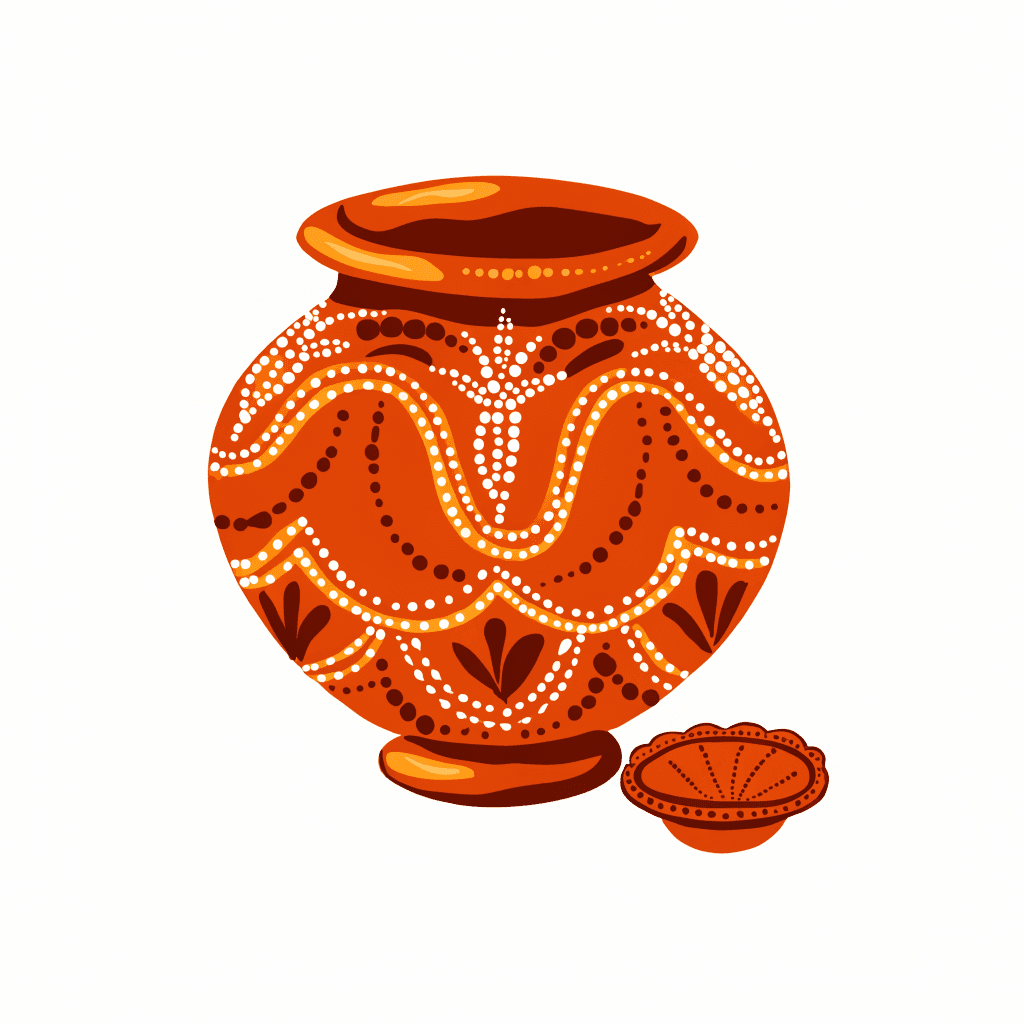
Khavda sits on the northern edge of Kutch, the last big village before the white salt flats of the Great Rann. Its Kumbhar potters have worked here for generations, digging clay from a lake bed near the village and turning it into round-bellied water pots, bowls and plates whose forms have often been compared to earthenware excavated at Harappan-era sites in the region — a reminder of how old this pottery language is. The work is divided by hand: men throw and shape the vessels on the wheel, while women paint them, laying down a base of red geru earth and then adding freehand patterns of white and black dots, dashes and lines, each stroke placed by eye and steady memory. Nothing is stencilled and no two pots match. Cheap steel and plastic vessels have eroded the everyday market, and the craft today rests with a small number of families in this one village. Their painted earthenware has instead found admirers among designers and collectors, who prize its unforced geometry — a desert craft that has kept its hand and its palette while almost everything around it changed.
How it is made
The clay comes from a lake bed near Khavda, cleaned and kneaded before it reaches the wheel. Vessels are thrown fast and thin, then dried in the desert air until leather-hard. Women of the family paint each piece: first a wash of geru, the local red ochre, then patterns built entirely from dots and fine lines in white and black slips, applied freehand with slender brushes. There are no stencils, so the rhythm of the motifs carries small human variations that identify the hand. The painted pots are fired at a low temperature in a simple kiln fuelled with wood and dung cake, emerging in the warm brick-red that defines Khavda ware.
Buying guide
Every genuine Khavda piece is painted freehand — look closely and the dots will vary slightly in size and spacing, which printed or stencilled imitations cannot fake. The body is unglazed, low-fired earthenware in a warm red, light for its size. Expect to pay roughly ₹400–₹6,000: small bowls and decor pieces at the lower end, large painted pots and lamp bases at the top. Buying this ware directly supports one of India's most fragile living pottery traditions.
Care
Khavda ware is low-fired and porous, so treat it as decorative rather than everyday kitchenware. Do not soak it or run it through a dishwasher; wipe with a barely damp cloth and dry immediately. Keep painted surfaces out of prolonged direct sun to preserve the mineral colours, and lift pots by the body, never the rim.
Good questions, honest answers
Can I use Khavda pottery for food or water?
Traditionally, yes — Khavda's round water pots kept drinking water cool through evaporation, exactly because the clay is porous. But most pieces sold today are painted for display, and soaking them can stain the surface. If you want a pot for actual water storage, tell the seller so they can supply one made and fired for that purpose.
Why is every pot slightly different?
Because nothing is stencilled. The geru base is brushed on by hand and every dot and line is placed by eye, usually by the women of a potter family. Small variations in spacing and stroke are the signature of authentic Khavda work — identical, machine-regular patterns are a sign of imitation.
What makes Khavda pottery rare?
The craft survives in a single village on the edge of the Great Rann, practised by a small number of Kumbhar families. There is no factory version and no second production centre, so each piece comes from a very small annual output — one reason collectors and designers seek it out.
Explore the living traditions
We are onboarding Khavda Pottery artisans. Meanwhile, explore every craft available on VedikCraft today.
Explore all crafts →
At a glance
- Region
- Khavda, Kutch, Gujarat
- Community
- Kutchi Kumbhar
- Materials
- clay, natural-pigment
- Techniques
- hand-painted earthenware
- Typical price band
- ₹400 – ₹6,000