Leather & Puppetry
The Kolhapuri Chappal, India's Hand-Stitched Classic
The story
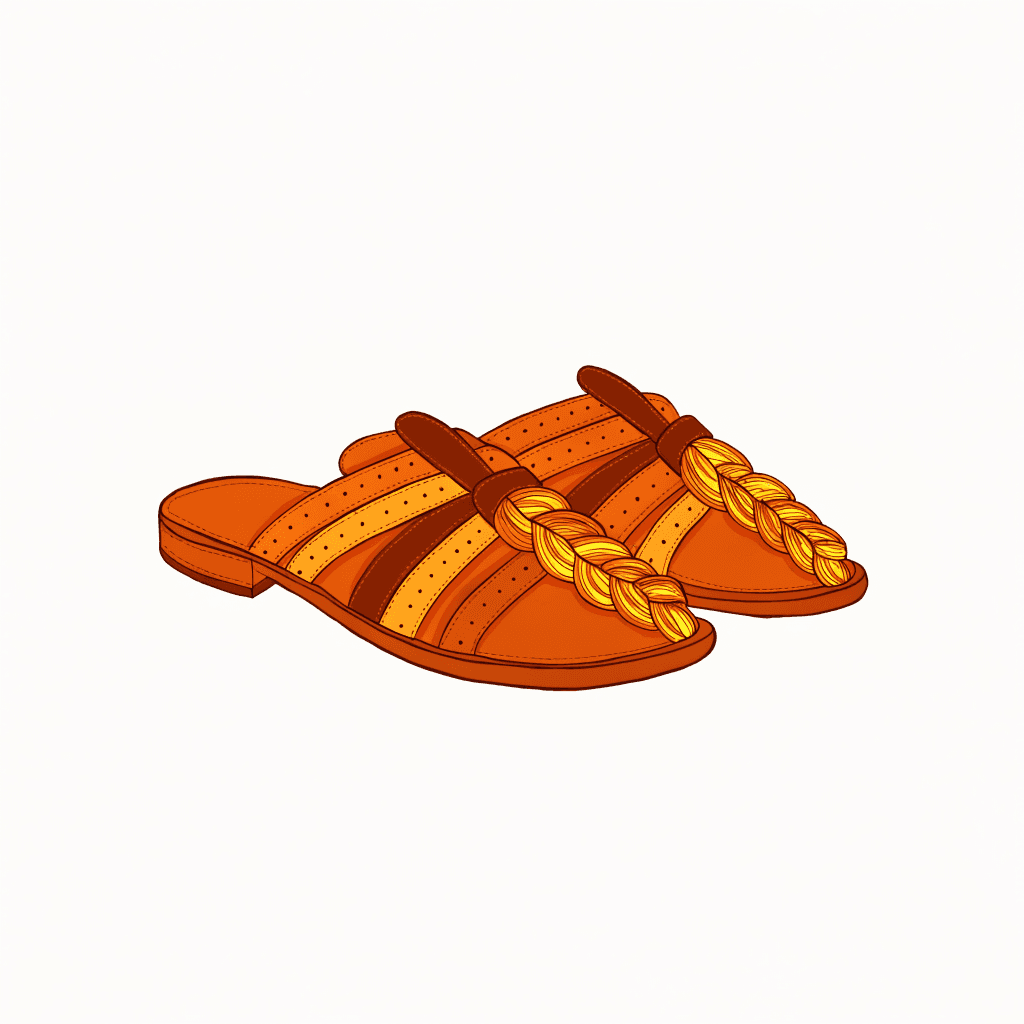
The Kolhapuri chappal is that rare thing: a regional village sandal that became a global design object without changing what it is. Its lineage in the Kolhapur region of Maharashtra is traced to the twelfth century, and the craft as we know it — open-toed, flat-soled, with the braided toe-loop and wide instep band — matured in the tanning and cobbling settlements of Kolhapur and neighbouring districts, including Athani across the Karnataka border. In the early twentieth century the craft received decisive patronage from Kolhapur's royal house, which encouraged its tanneries and gave the sandal the name it carries worldwide. Everything about a true Kolhapuri is pre-industrial in the best sense: hide tanned slowly with vegetable matter such as myrobalan, cut and layered by hand, and stitched with leather cord — no nails, no synthetic adhesives, no machine parts. The result is a sandal that begins stiff, then moulds to its wearer's foot and lasts years of hard use. From village markets it has travelled onto international runways, while the making itself remains with hereditary artisan families in Maharashtra and Karnataka, now protected by a Geographical Indication shared across both states.
How it is made
A Kolhapuri begins in the tanning pit: hides are cured with vegetable tannins — myrobalan (hirda) and babul bark among them — over weeks, a slow process that gives the leather its characteristic tan colour, firmness and earthy smell. The sole is built from layered leather, cut to the foot and pounded dense. The upper — a broad instep band and the signature toe-loop, often finished with fine leather braiding — is cut, skived and decorated with punching or plaited detail. Every element is then joined by hand-stitching with leather cord; a genuine Kolhapuri uses no nails and no synthetic glue. Finally the sandal is buffed and its edges smoothed. Each pair passes through many pairs of hands, from tanner to stitcher to finisher.
Buying guide
Smell and flex are the fastest tests: vegetable-tanned leather has a warm, earthy smell and a firm, dense feel, while chrome-tanned imitations smell chemical and feel spongy. Turn the pair over — you should see leather soles and hand-stitching with leather cord, not moulded rubber or machine lockstitch. Expect slight asymmetry between the pair; that is the hand at work. Genuine pairs typically run ₹600–₹2,500, with finely braided and detailed styles reaching ₹6,000.
Care
New Kolhapuris are stiff by design — wear them in short stretches for the first week and they will mould to your feet. Keep them dry; if soaked, stuff with paper and dry in shade, never in sunlight or near a heater. Condition the leather every few months with a neutral leather balm or a drop of coconut oil, and store them ventilated.
Good questions, honest answers
Are Kolhapuris comfortable for daily wear?
After breaking in, exceptionally so. The layered leather sole compacts and shapes itself to your footprint over the first weeks, effectively becoming a custom footbed. They suit dry, warm climates best — the flat sole and open design breathe well. If you have gait issues or need arch support, treat them as flat sandals, because that is what they are.
How do I spot a fake Kolhapuri?
Check the sole and the stitching. A genuine pair has leather soles stitched with leather cord, visible and slightly irregular; fakes use rubber soles, machine stitching or glued construction. The leather should be firm and earthy-smelling, in natural tan shades. Prices far below the ₹600 mark, perfect uniformity between pairs and a chemical smell all point to imitation.
Can I wear Kolhapuris in the rain?
Best not to. Vegetable-tanned leather absorbs water readily; a soaking can stiffen, stain or warp the sole. If your pair does get wet, stuff it with newspaper, dry it slowly in shade away from heat, then condition the leather once fully dry. Many wearers simply keep other footwear for the monsoon and let the Kolhapuris sit out the season.
Explore the living traditions
We are onboarding Kolhapuri Chappal artisans. Meanwhile, explore every craft available on VedikCraft today.
Explore all crafts →
At a glance
- Regions
- Kolhapur, Maharashtra · Athani, Karnataka
- Community
- Kolhapur & Athani artisans
- Materials
- vegetable-tanned leather
- Techniques
- hand-stitching, braiding
- Typical price band
- ₹600 – ₹6,000