Leather & Puppetry
The Kathputli Puppets of Rajasthan's Bhat Bards
The story
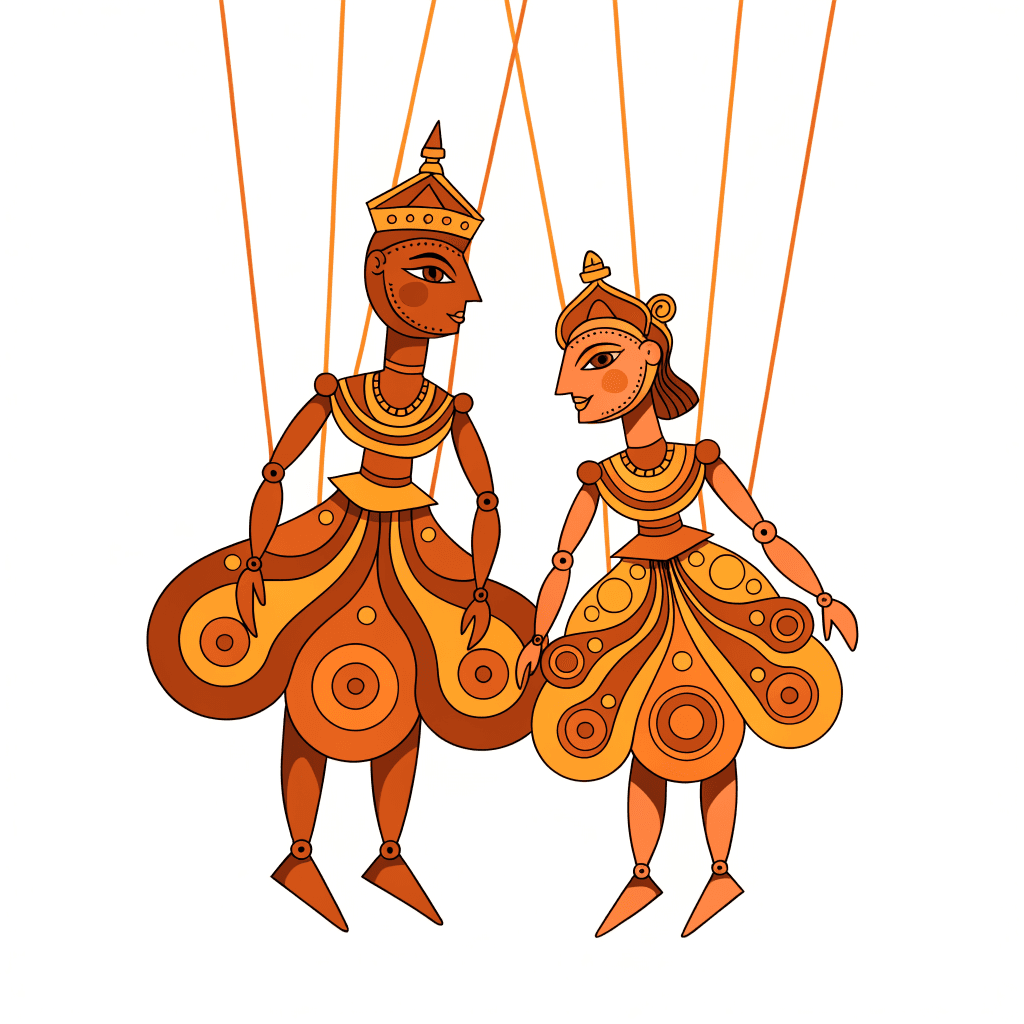
Kathputli takes its name from kath (wood) and putli (doll), and by tradition the craft is around a thousand years old — the hereditary art of the Bhat community, nomadic bards who carried their portable theatre from village to village across Rajasthan and beyond. A kathputli troupe needed no stage: a cot turned on its side, a curtain, an oil lamp, a dholak drum and a trunk of puppets was enough to summon courtly legends — most famously the exploits of Amar Singh Rathore, the swaggering Rajput noble — along with dancers, horsemen, snake charmers and sly satire on local affairs. The puppeteer speaks through a boli, a small reed whistle held in the mouth that gives the puppets their shrill, unmistakable voice, while his hands work the strings and the rest of the family sings and drums. The puppets themselves are instantly recognisable: large painted eyes on a carved wooden head, bright stitched costumes flashing with mirrors and gota trim, and a long trailing skirt in place of legs. Patronised once by Rajput courts, kathputli survives today through performance troupes, craft markets and collectors of Rajasthani folk art.
How it is made
The head and chest are carved from a single piece of light local wood — mango is common — then smoothed and painted: a pale face, arched brows, and the oversized, kohl-lined eyes that give kathputli its expressive stare. Moustaches, turbans and jewellery are painted or applied according to the character. The body below is soft — arms of stuffed cloth, a bright skirt of layered fabric stitched with mirrors, sequins and metallic gota — which is what lets the puppet whirl and snap with such life. Strings are attached to the head and hands, and sometimes the waist; traditional performers use no wooden control bar, looping the strings directly over their fingers. A dancing puppet may be strung to spin, somersault or ride a cloth horse.
Buying guide
Look first at the head: it should be carved wood, with visible tool character under the paint, not moulded plastic or plaster. Hand-painted features vary slightly from puppet to puppet — perfect uniformity is a factory tell. Costumes should be stitched fabric with real mirror or gota work, and strings functional, not merely decorative. Simple souvenir puppets start around ₹150–₹500; large, finely carved performance-grade puppets and character sets range up to ₹5,000.
Care
Hang or stand puppets free of tangling, and away from direct sun that fades the painted face and fabrics. Dust with a dry soft brush; never wet the wood or costume. Untangle strings gently rather than pulling. In humid months, keep them out of damp rooms so the cloth body and gota trim stay crisp.
Good questions, honest answers
Who are the Bhat puppeteers?
The Bhats are a community of hereditary performers and genealogist-bards from Rajasthan who, by their own tradition, have practised kathputli for centuries, travelling between villages and courts. The art passes within families — carving, stitching, singing, drumming and string-work all handled by the household. Many Bhat families continue to perform today in cities and at festivals.
Why do kathputli puppets have no legs?
The long trailing skirt is a deliberate design. It hides the absence of legs while amplifying movement — a flick of the strings sends the skirt swirling, so the puppet seems to dance, leap or gallop with far more life than jointed legs would give. It also makes the puppet lighter, faster to make, and easier to pack for a travelling troupe.
Are these puppets usable or just decorative?
Performance-grade kathputli are fully functional string puppets — strung, balanced and ready to dance with a little practice. Many buyers, though, display them: hung on walls, seated on shelves or framed, where their mirrored costumes and painted faces work as vivid Rajasthani folk art. If you intend to perform, ask for a properly strung puppet rather than a purely decorative one.
Explore the living traditions
We are onboarding Rajasthani Kathputli Puppets artisans. Meanwhile, explore every craft available on VedikCraft today.
Explore all crafts →
At a glance
- Region
- Rajasthan
- Community
- Bhat puppeteers
- Materials
- wood, cloth, string
- Techniques
- carved-head string puppetry
- Typical price band
- ₹150 – ₹5,000