Paintings & Folk Art
Sohrai and Khovar, the Painted Walls of Hazaribagh
The story
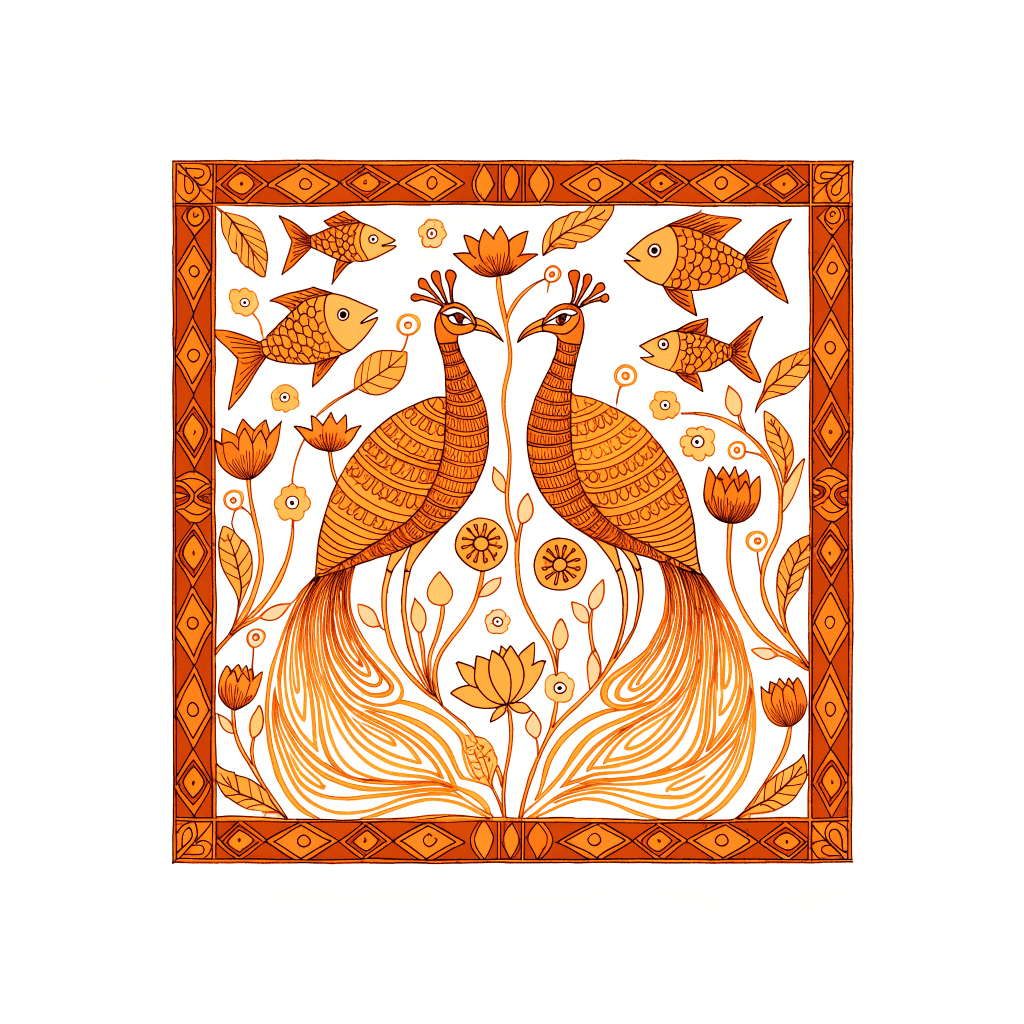
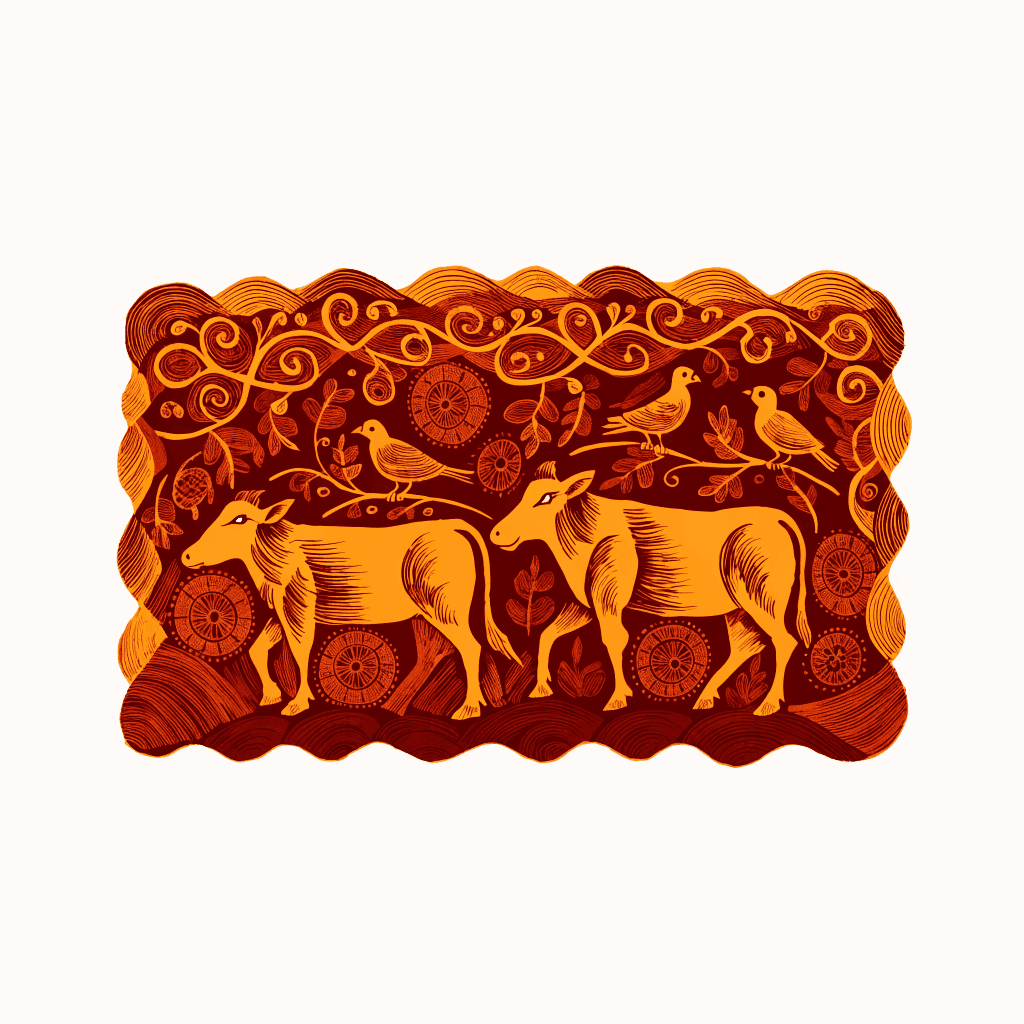
In the villages around Hazaribagh in Jharkhand, painting belongs to women and to the turning of the year. Sohrai is the art of the harvest festival that follows Diwali, when cattle are honoured and courtyard walls fill with bulls, birds, wild animals and flowering forest plants. Khovar is its counterpart for the wedding season: the walls of the bridal room are layered with dark earth over white, then combed while still wet so pale lines emerge from the black — an art of revealing rather than applying. Both traditions are carried by women of the Kurmi, Santhal, Oraon and neighbouring communities, passed from mother to daughter, and both are painted entirely with what the land provides — red and yellow ochres, white kaolin, black manganese-rich earth. Scholars have long noted how closely these animal forms echo the prehistoric rock art found in the same region, hinting at a visual language of remarkable age. In recent decades the painters have brought their murals onto paper and canvas for wider audiences, and in 2020 Sohrai Khovar painting received a Geographical Indication, formally binding the art to Hazaribagh and the women who make it.
How it is made
The palette is dug, not bought. Painters gather earths near their villages — red geru, yellow ochre, a milky white kaolin called dudhi, and a black, manganese-rich soil — and mix them with water. For Khovar, the wall or canvas is coated light, layered over with dark earth, then combed with broken comb pieces or drawn through with fingertips while wet, cutting away the top coat so the pale ground reappears as lines. For Sohrai, designs are painted on directly with cloth daubs and brushes made from chewed twigs. Animals are drawn in bold outline and filled with hatching and dots. On canvas and paper, the same earth pigments are set with a natural binder so the matte, mineral character survives the journey.
Buying guide
Authentic work has a matte, mineral quality — earth reds, ochre yellows, soft blacks and whites — that acrylic copies miss, usually by being too bright. In Khovar pieces, look for genuine comb-drawn lines where the top layer has been cut away; in Sohrai, for confident freehand animals filled with hatching. Paper works typically start around ₹800, with large canvases by recognised painters reaching ₹40,000. GI-tagged pieces traceable to Hazaribagh women's collectives are the gold standard.
Care
Earth pigments sit matte on the surface and can smudge, so never wipe a painting with a damp cloth. Frame paper and canvas works behind glass, keep them off damp walls and out of direct sun, and dust the frame only. Handled this way, the mineral palette is remarkably stable — these are, after all, colours that survive on rock.
Good questions, honest answers
What is the difference between Sohrai and Khovar?
Sohrai is harvest art, made for the cattle festival after Diwali: designs are painted onto the wall with earth colours, celebrating bulls, birds and forest life. Khovar is marriage art, made for the bridal room: a dark earth layer is combed away while wet to reveal light lines beneath. One is painted on, the other cut out — and both come from the same women's hands.
Are the colours really just earth?
Yes. The traditional palette is dug locally: red geru, yellow ochre, white kaolin and a manganese-rich black soil, mixed with water and, on canvas, a natural binder. That is why authentic work looks muted and mineral rather than glossy. If a 'Sohrai' painting glows with saturated acrylic colour, it is a reinterpretation, not the traditional practice.
Who makes Sohrai and Khovar paintings?
Women of the Kurmi, Santhal, Oraon and neighbouring communities around Hazaribagh, in a tradition handed from mother to daughter. The murals are still renewed seasonally on village houses, and many of the same painters now work on paper and canvas so the art can be collected — with the 2020 GI recognising both the region and its women artists.
Explore the living traditions
We are onboarding Sohrai & Khovar Painting artisans. Meanwhile, explore every craft available on VedikCraft today.
Explore all crafts →
At a glance
- Region
- Hazaribagh, Jharkhand
- Community
- Jharkhand tribal women (Kurmi, Santhal, Oraon)
- Materials
- natural-mud-pigment, wall, canvas
- Techniques
- comb-cut & finger mural painting
- Typical price band
- ₹800 – ₹40,000