Textiles & Handloom
Chamba Rumal — Pahari Painting by Needle
The story
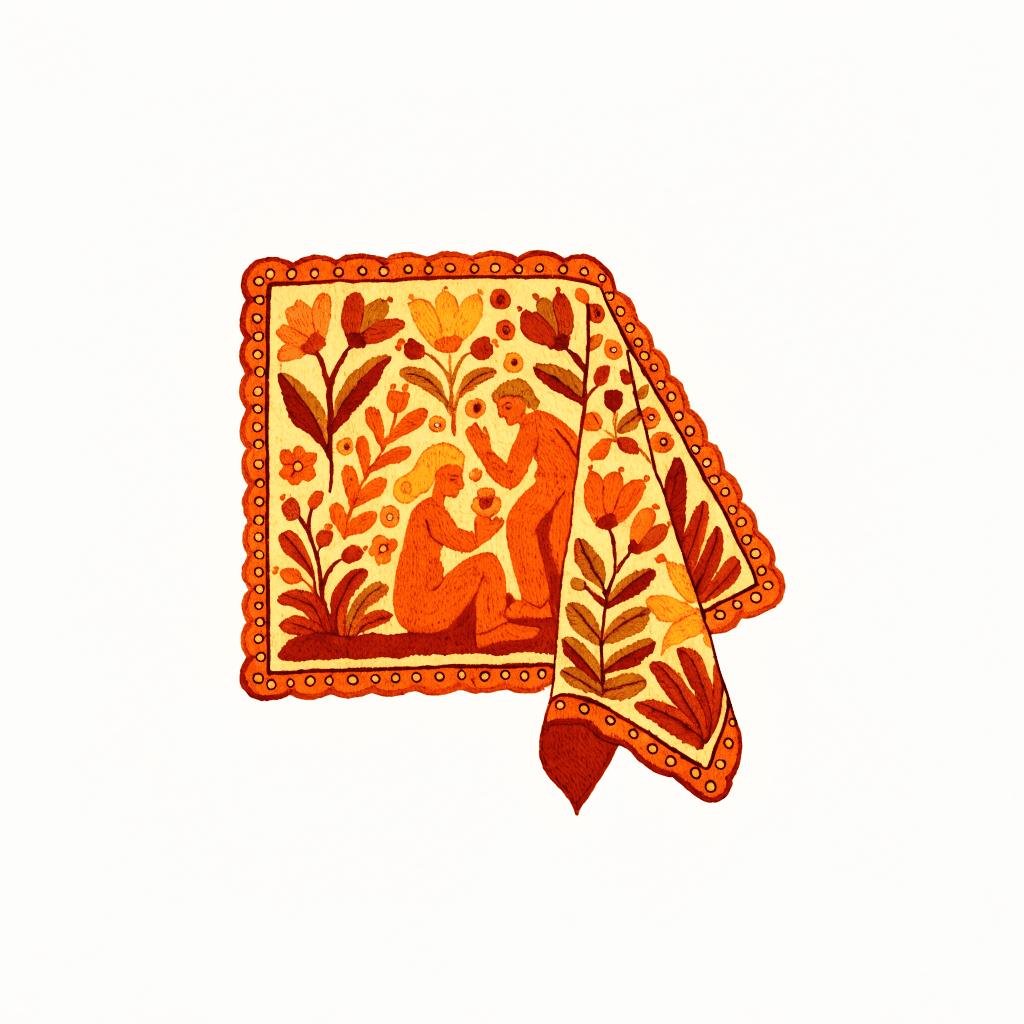
In the hill state of Chamba, embroidery and painting grew up as sisters. Between roughly the seventeenth and nineteenth centuries, the Pahari courts of Himachal nurtured a celebrated school of miniature painting, and its idiom crossed into thread in the women's quarters of palaces and homes. Compositions were often drawn onto cloth by artists trained in the miniature tradition, then embroidered by the women of Chamba — which is why finished rumals are called 'needle paintings', sharing the same lyrical figures, pavilions and flowering trees as paintings on paper. A rumal is literally a kerchief or coverlet, and that was its role: draped over trays of wedding gifts and temple offerings, exchanged between families as tokens of honour. Krishna's raas-leela is the beloved subject — the god multiplied among dancing gopis in a ring — alongside hunting scenes, weddings and episodes from the epics. The craft's defining feat is the do-rukha, or double-faced, satin stitch: the embroidery emerges identical on both sides of the cloth, with no visible 'wrong' face. After a long twentieth-century decline, dedicated revival efforts returned the rumal to serious practice, and fine examples now hang in museums worldwide.
How it is made
A rumal begins with fine unbleached muslin, hand-spun cotton or occasionally silk. The composition is drawn onto it in charcoal or light brush outline, following Pahari miniature conventions — figures arranged in circles or registers, borders of flowering vines. The embroiderer then works in untwisted silk floss, called pat, whose lack of twist gives the surface a soft, painterly sheen. The defining do-rukha double-satin stitch carries the thread through the cloth so both faces fill identically: there is no wrong side. Fine stem or double running stitch sharpens the outlines. Colours follow the miniature palette — lac reds, indigo, ochre, leaf green. A large narrative rumal can absorb months, the embroiderer in effect painting the same picture twice with every pass of the needle.
Buying guide
Flip it over — the test is built into the craft. A genuine Chamba Rumal reads identically on both faces, with no knots, floats or reversed stitches visible anywhere. The floss should be untwisted silk with a soft sheen, the drawing assured and miniature-like. Single-sided satin work or printed 'rumal-style' panels are not the real thing. Small pieces typically start around ₹1,500, while large, museum-grade narrative rumals can reach ₹80,000.
Care
Treat a rumal as textile art. Frame larger pieces behind glass, away from direct sunlight, which fades silk floss. Never machine-wash; if cleaning is needed, trust a specialist dry cleaner with embroidered silk. Store flat, or rolled around an acid-free tube in muslin — folding creases the satin stitch. Handle with dry, clean hands; the floss snags easily.
Good questions, honest answers
What does do-rukha mean?
Do-rukha means 'two-faced' — the stitch technique at the heart of the Chamba Rumal. The double satin stitch is worked so the silk floss fills the design equally on both sides of the cloth, leaving no reverse, no knots and no floats. It is the craft's signature feat and the quickest authenticity test: turn the piece over and the picture should simply repeat.
How is a Chamba Rumal used or displayed?
Traditionally it covered gifts and offerings — draped over trays at weddings and temple ceremonies as a mark of honour. Today most collectors treat rumals as wall art, framed behind glass like the miniature paintings they descend from. Smaller pieces also serve as ceremonial covers or heirloom gifts. Either way, the double-faced embroidery rewards mounting that lets both sides be appreciated.
What subjects appear on Chamba Rumals?
Krishna's raas-leela — the circular dance with the gopis — is the most beloved composition, perfectly suited to the rumal's square format. Embroiderers also render wedding processions, hunting scenes, the game of chaupar, and episodes from the Ramayana and Mahabharata, all bordered with flowering vines. The iconography comes directly from Pahari miniature painting, which supplied the original drawings.
Explore the living traditions
We are onboarding Chamba Rumal artisans. Meanwhile, explore every craft available on VedikCraft today.
Explore all crafts →
At a glance
- Region
- Chamba, Himachal Pradesh
- Community
- Chamba women
- Materials
- fine-cotton/silk, silk-floss
- Techniques
- double-satin do-rukha embroidery
- Typical price band
- ₹1,500 – ₹80,000