Textiles & Handloom
Kinnauri Shawls, Woven at the Edge of Tibet
The story
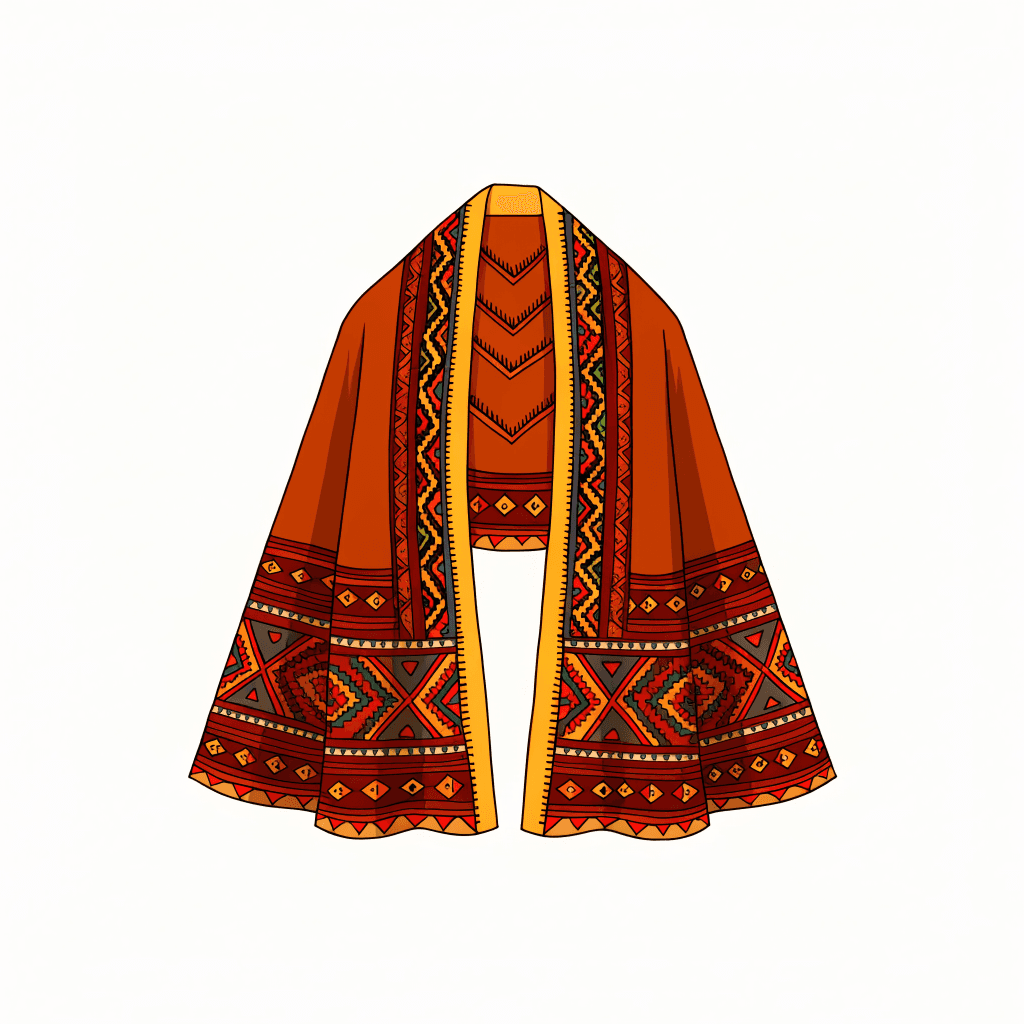
Kinnaur sits at the top of Himachal Pradesh, its villages strung along the Sutlej gorge on the old Hindustan–Tibet trade road. Wool moved along that road for centuries — sheep fleece, pashmina and yak fibre passing between the Tibetan plateau and the Indian plains — and Kinnauri weavers stood at the crossing point, absorbing pattern ideas from both worlds. Their shawls show it: borders of stepped diamonds, crosses and lozenges that carry Central Asian and Tibetan Buddhist echoes, unlike anything woven elsewhere in the Indian hills. The weaving was never decoration alone. In local tradition the patterned bands speak a symbolic language — the classic palette of white, yellow, red, green and blue is widely associated with the five elements, and motifs are chosen for auspiciousness and protection. A fine shawl worn over the shoulders, paired with the region's green-banded felt cap, remains the ceremonial dress of the valleys, brought out for weddings, harvest festivals and temple fairs. For generations, weaving filled the long snowbound winters, supplementing mountain agriculture and orchard work. That rhythm survives: the finest Kinnauri shawls are still woven slowly, border by border, in one of India's most remote craft regions.
How it is made
The body of a Kinnauri shawl is woven plain, in local sheep wool, merino, pashmina or yak wool depending on grade. The glory is in the borders: patterned bands built by interlocked-tapestry and extra-weft techniques, in which the weaver inserts each coloured motif by hand, thread by thread, rather than throwing a shuttle across. Traditional motifs — stepped diamonds, crosses, hooked lozenges — are worked in the classic five-colour palette against the natural ground. The patterning is so dense and slow that a richly bordered shawl's bands can take longer than its entire plain body. Finishing includes washing, brushing and twisting the fringes; a top-grade pashmina or yak-wool piece is warm far beyond its weight.
Buying guide
Look closely at the border patterning: in genuine tapestry-woven work the motifs are built into the cloth, with small colour joins visible on the reverse — not embroidered on top or printed. The classic five-colour geometry should be crisp and symmetrical. Fibre drives price: sheep-wool pieces typically start around ₹2,000, while merino, pashmina and yak-wool shawls with dense borders range toward ₹30,000. Very cheap 'Kinnauri' shawls in tourist markets are usually powerloom imitations.
Care
Dry clean, or hand-wash cold with a wool-safe detergent, pressing water out gently — never wringing. Dry flat in shade, reshaping while damp. Store folded with dried neem leaves or cedar blocks against moths, which love mountain wool. Air the shawl in mild sun once a season, and let it rest between wearings so the fibre recovers.
Good questions, honest answers
What do the colours on a Kinnauri shawl mean?
In Kinnauri tradition the classic palette — white, yellow, red, green and blue — is widely associated with the five elements, and the geometric motifs woven in these colours are chosen for auspiciousness and protection. The border bands are a symbolic language as much as ornament, which is why traditional weavers keep their sequence and symmetry so disciplined.
Are Kinnauri shawls made of pashmina?
Some are. Kinnauri shawls are woven in a range of fibres — local sheep wool, fine merino, yak wool and pashmina — and the fibre largely determines warmth, softness and price. The identity of the shawl lies in its patterned tapestry borders rather than in any one fibre. Ask specifically what the body is woven from before buying.
How do I spot a machine-made imitation?
Turn the border over. Hand-woven tapestry patterning shows tidy interlocked colour joins and slight irregularities on the reverse; powerloom copies look mechanically perfect or carry long floats of thread. Genuine pieces also feel denser at the borders than in the body. Price is a signal too — authentic Kinnauri weaving from the high valleys cannot be sold at throwaway rates.
Explore the living traditions
We are onboarding Kinnauri Shawl artisans. Meanwhile, explore every craft available on VedikCraft today.
Explore all crafts →
At a glance
- Region
- Kinnaur, Himachal Pradesh
- Community
- Kinnauri weavers
- Materials
- wool, pashmina, yak-wool
- Techniques
- geometric tapestry border weaving
- Typical price band
- ₹2,000 – ₹30,000