Paintings & Folk Art
Paitkar: Jharkhand's Singing Scroll Paintings
The story
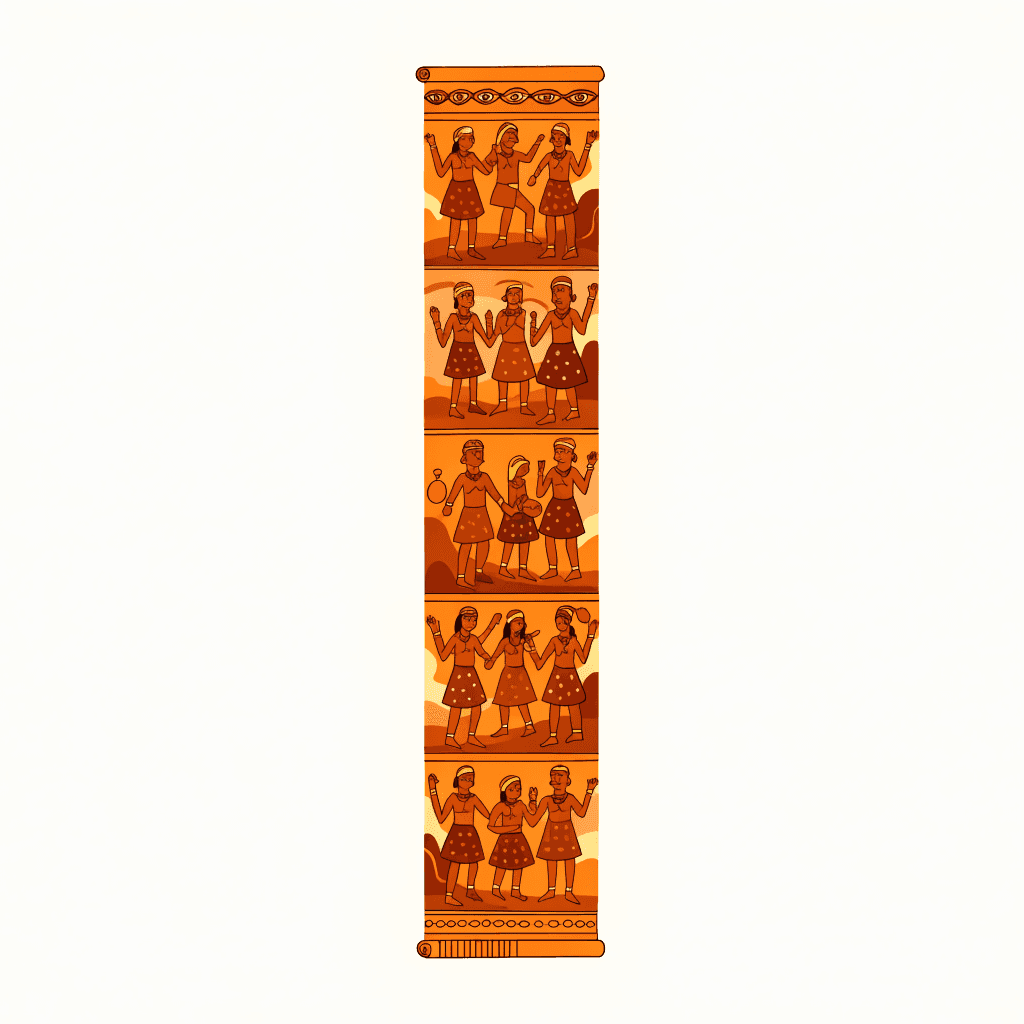
Paitkar is counted among India's oldest scroll-painting traditions, kept alive by Chitrakar families of East Singhbhum in Jharkhand, most famously in and around the village of Amadubi. These were performances before they were pictures: a painter-bard travelled with rolled scrolls, unrolling them register by register before an audience while singing the story each frame carried. The repertoire is rooted in the Santhal world — creation stories, scenes of village and forest life, and above all the journey of the soul after death, sung for families in mourning — alongside episodes from Hindu epics absorbed over centuries of exchange. The style is instantly readable: figures in profile with large, expressive eyes, arranged in horizontal bands, coloured in soft earth and plant tones on paper. Painting and song were a single livelihood, and the picture was never meant to stand silent on a wall. The tradition has thinned to a small number of practising families, but craft-village initiatives, museum attention and new collectors have given the scrolls a second audience — one that buys them as art, even as the older performance tradition survives in fragments.
How it is made
Paitkar painters work on paper, traditionally joining sheets into long vertical scrolls divided into narrative registers. The colours come from the landscape: ochre stones ground for reds and yellows, leaves and flowers for greens, lamp soot for black — prepared on a grinding stone and bound with natural tree gum. Brushes are slender, often made from animal hair set into a stick. The painter lays out the story first, frame by frame, then draws the profile figures with their oversized eyes and fills them with flat, soft colour. Borders tie the registers together so the scroll reads as one continuous song. No two scrolls repeat exactly; each is a fresh telling.
Buying guide
Look for the hallmarks of the genuine article: handmade or joined paper, narrative registers that read as a sequence, profile figures with large eyes, and the soft, slightly uneven hues of stone and plant colours — chemical paints look flat and loud by comparison. Small single-frame paintings typically start around ₹800; long, multi-register story scrolls by senior painters reach ₹15,000. A scroll whose seller can tell you the story it sings is a scroll worth buying.
Care
Store and display Paitkar work flat or framed rather than repeatedly rolled — old paper and natural pigment crack along fold lines. Frame behind glass with acid-free backing, hang away from sun and damp, and never laminate a scroll, which destroys both surface and value. If a long scroll must be stored rolled, roll it loosely around a wide tube and wrap it in soft cotton.
Good questions, honest answers
What stories do Paitkar scrolls tell?
The core repertoire comes from the Santhal world: creation narratives, village and forest life, and the soul's journey after death, traditionally sung for grieving families. Hindu epic episodes appear too, absorbed over centuries of living side by side. Each scroll is a script as much as a picture — the painter-singer moved through it register by register, verse by verse.
Why are the paintings arranged in strips or bands?
Because the scroll was a performance tool. Each horizontal register holds one scene of the story, and the bard revealed them in order as the song progressed, unrolling the scroll like a slow film. Even framed single panels keep this register logic — it is the tradition's structural signature and one of the easiest ways to recognise genuine Paitkar work.
Is Paitkar painting rare?
Genuinely so. Only a small number of Chitrakar families in East Singhbhum, centred on Amadubi village, still practise the art, and every piece is painted by hand with locally made colours. That scarcity shows less in high prices than in limited supply — which makes provenance, and buying from sources connected to the painter families, matter all the more.
Explore the living traditions
We are onboarding Paitkar Scroll Painting artisans. Meanwhile, explore every craft available on VedikCraft today.
Explore all crafts →
At a glance
- Region
- East Singhbhum, Jharkhand
- Community
- Chitrakar / Paitkar painters
- Materials
- paper, natural-pigment
- Techniques
- narrative scroll painting
- Typical price band
- ₹800 – ₹15,000