Textiles & Handloom
Kutch Embroidery: Mirror-Work from Gujarat's Desert
Also known as Rabari, Ahir, Mutwa
The story
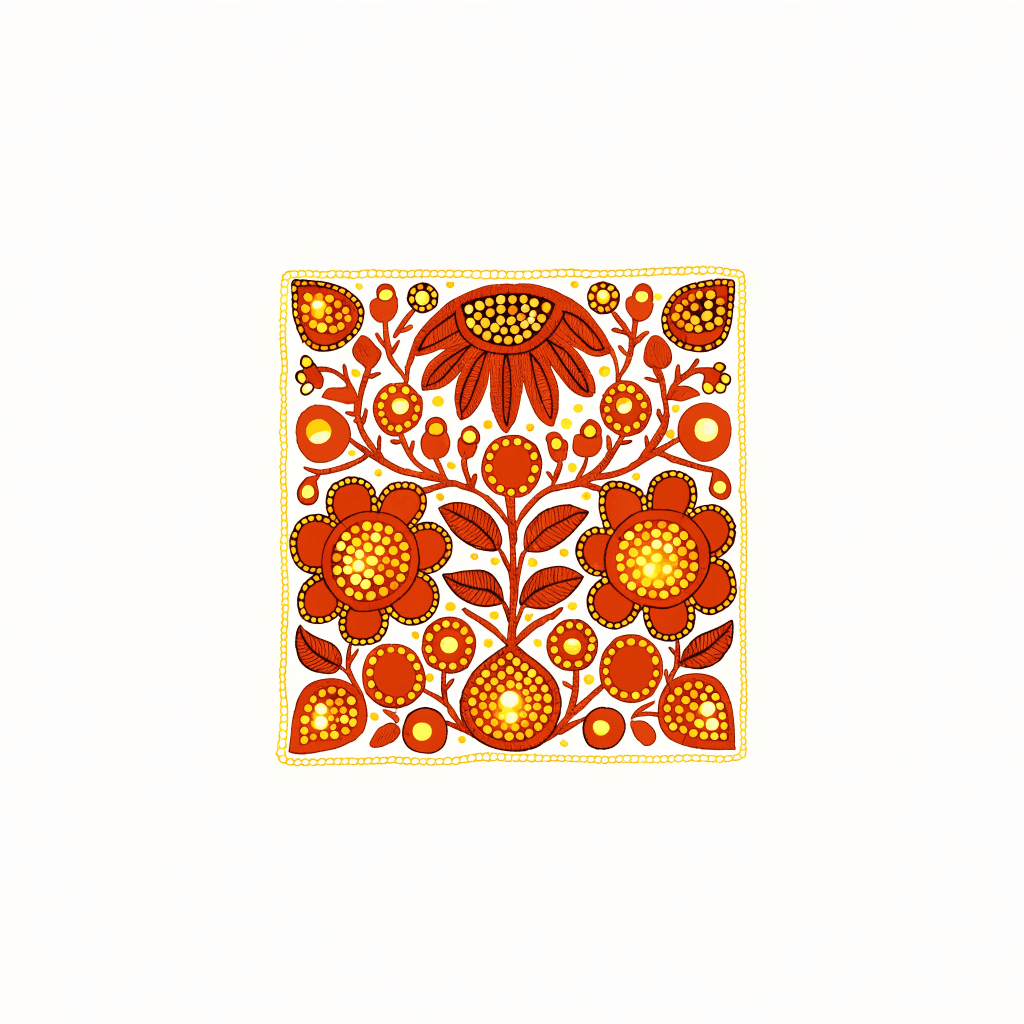
Kutch embroidery is not one craft but a family of them. Across the salt flats and scrub of Gujarat's westernmost district, each community guards its own stitch vocabulary: the Rabari with bold chain stitch and large mirrors, the Ahir with flowing hooked motifs anchored by round mirrors, the Mutwa of Banni with stitches so fine the mirrors shrink to the size of grain. A trained eye can read a woman's community, village and marital status from the front of her blouse. These vocabularies travelled with pastoralist and settler communities who crossed into Kutch from Sindh and Rajasthan over the centuries, and for most of that time the work was never for sale. It was dowry embroidery — kanjari blouses, wedding canopies, children's bonnets and camel trappings stitched by girls from childhood as a record of skill and belonging. The mirrors, called abhla, were sewn in to catch desert light and deflect the evil eye. After the devastating earthquake of 2001, embroidery became a vital income for thousands of Kutchi households, and dowry skills moved to the marketplace. What reaches you today carries that whole lineage: identity, protection and patience, one stitch at a time.
How it is made
The base is usually handwoven cotton or silk, sometimes pre-marked with a light printed guide, though many embroiderers work entirely freehand. Chain stitch, herringbone, interlacing and buttonhole form the core repertoire, worked in saturated silk-thread colours — crimson, saffron, emerald, ink blue. The signature mirror-work follows its own sequence: an abhla mirror is held down by a grid of foundation threads, then locked in place with a tight ring of buttonhole stitches, so no adhesive is ever used. Each community's rules govern motif, colour order and mirror placement. A small pouch may take days; a fully embroidered wedding textile can absorb months of a stitcher's evenings, worked between household tasks in courtyard light.
Buying guide
Turn the piece over: hand embroidery shows travelling threads, knots and slight tension variations on the reverse, while machine work looks uniformly flat. Mirrors should be locked in with a stitched buttonhole ring — glued or stapled sequins are the giveaway of imitation. Ask which community style the piece follows; sellers of genuine work usually know. Prices track stitch density and coverage, typically ranging from around ₹800 for small pouches and accessories to ₹50,000 for densely worked panels and heirloom textiles.
Care
Dry cleaning is safest for heavily mirrored pieces. If washing, use cold water and a mild liquid detergent, soak briefly, and never wring — twisting stresses the threads anchoring each mirror. Dry flat in shade, and iron on the reverse with a cloth in between. Store folded in muslin, refolding along new lines every few months so creases don't set through the embroidery.
Good questions, honest answers
How do I tell handmade Kutch embroidery from machine imitation?
Check the reverse of the fabric. Handwork shows knots, travelling threads and small irregularities; machine embroidery is flat and perfectly repetitive. The mirrors are the clearest test — genuine abhla are held by a hand-stitched buttonhole ring with no glue. Slight variations in stitch size across the piece are a sign of authenticity, not a flaw.
What is the significance of the mirrors in Kutch embroidery?
The mirrors, called abhla, are traditionally believed to deflect the evil eye by reflecting it away from the wearer. Practically, they animate the textile — a mirrored blouse or canopy glitters as light moves across it, which mattered in a desert landscape of strong sun and firelight. Their size and placement also differ by community, so they carry identity too.
Are all Kutch embroidery styles the same?
No — Kutch is home to many distinct traditions. Rabari embroidery is bold, with heavy chain stitch and large mirrors; Ahir work flows in curling motifs around round mirrors; Mutwa embroidery from the Banni grasslands is famously minute and precise. Each community historically stitched for its own dowries, so the styles stayed distinct rather than blending.
Explore the living traditions
We are onboarding Kutch Embroidery artisans. Meanwhile, explore every craft available on VedikCraft today.
Explore all crafts →
At a glance
- Region
- Kutch, Gujarat
- Community
- Rabari, Ahir, Mutwa & other Kutchi communities
- Materials
- cotton, silk-thread, mirror
- Techniques
- mirror-work, chain & herringbone stitch
- Typical price band
- ₹800 – ₹50,000