Glass, Paper & More
Sanjhi, the Paper Stencil Art Cut for Krishna
The story
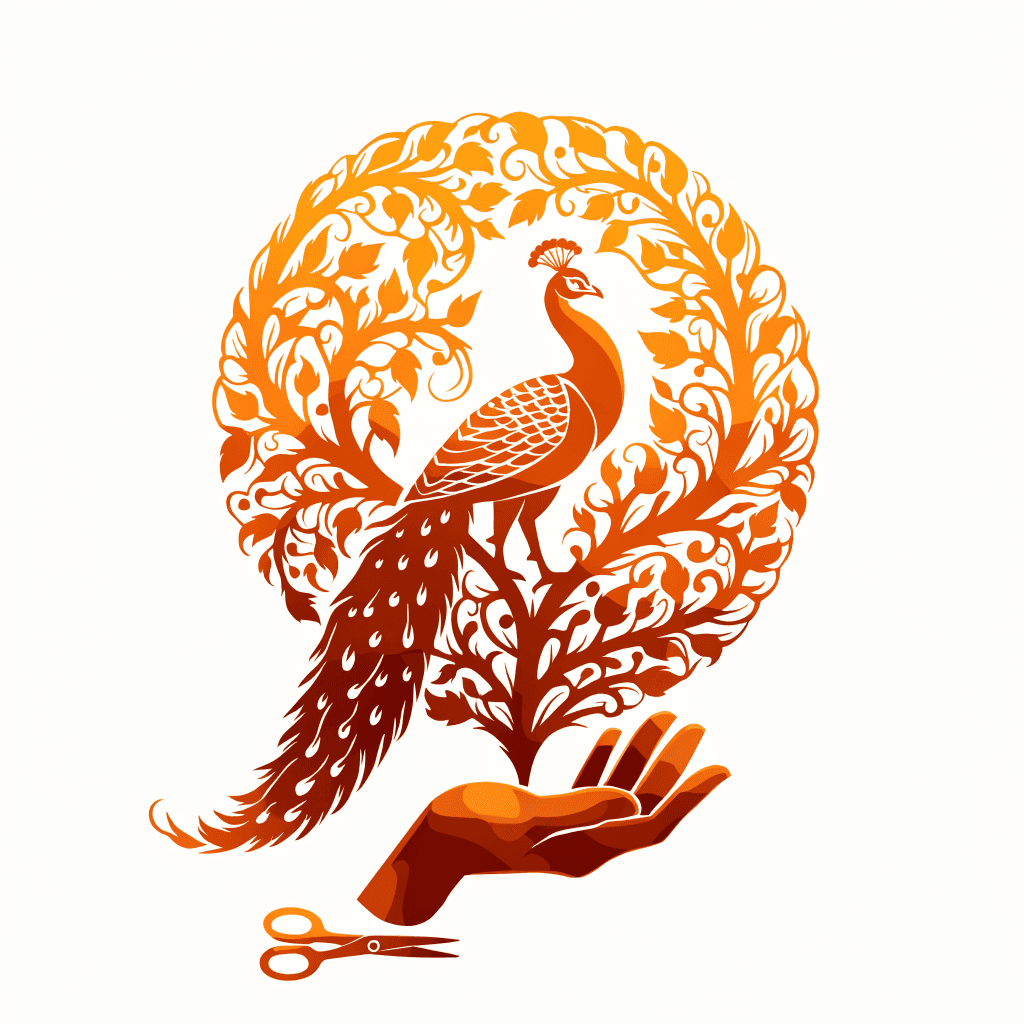
Sanjhi belongs to the temple towns of Mathura and Vrindavan, and to the evening hour its name evokes — sanjhi is linked to sandhya, dusk, when the finished images were traditionally unveiled. Legend holds that Radha herself made the first sanjhi to delight Krishna, and the craft has remained an act of devotion ever since: temple artists cut fantastically intricate stencils from paper, then sift dry colours through them onto polished floors — and even onto the still surface of water — to conjure scenes of Krishna-leela that live for a single evening. For generations the technique was closely guarded within temple families, taught as service rather than trade. The stencil was a tool, discarded once the rangoli was made. Only in recent decades did the world recognise that the stencil itself — paper cut into lace, with lattices finer than a fingernail — is a masterpiece worth keeping. Today sanjhi cutouts are framed as standalone art and collected in India and abroad, while a small circle of Vrindavan artists keeps both practices alive: the framed paper for the wall, and the ephemeral coloured image for the god.
How it is made
A sanjhi begins as a single sheet of paper and a pair of small, fine scissors — often custom-made, and in skilled hands more drawing instrument than cutting tool. The artist sketches the composition or works from memory, then cuts away the negative space, leaving peacocks, cows, kadamba trees and the figure of Krishna suspended in a web of connecting strands. Nothing is glued or assembled; if a strand is severed in the wrong place, the piece is compromised. For the ritual form, the finished stencil is laid on the floor or on water and dry colours are sifted through it before the stencil is lifted to reveal the image. For framing, the cutout itself is mounted, usually between glass, so both faces show.
Buying guide
Study the fineness and continuity of the cutwork: every element should connect to the whole, with no glued repairs or breaks. Finer lattice, steadier lines and more complex compositions command higher prices — simple framed pieces start around ₹500, while large, museum-fine works reach ₹30,000. Insist on proper mounting; a sanjhi pressed loosely against a mat will ripple. Ask whether the work is cut from a single sheet — in traditional sanjhi, it always is.
Care
Keep sanjhi framed behind glass and never handle the bare cutout — the strands are fragile and absorb skin oils. Hang away from direct sunlight, which yellows and embrittles paper, and out of humid rooms like kitchens and baths. If a piece must be moved unframed, support it fully on a stiff board rather than lifting it by an edge.
Good questions, honest answers
What do sanjhi artworks depict?
The heart of sanjhi is Krishna-leela — Krishna and Radha, gopis, cows, peacocks, the kadamba tree and the groves and ghats of Vrindavan. Rangoli stencils also carry lotuses, borders and geometric medallions. Because the craft grew inside temple worship, even ornamental pieces tend to keep a devotional grammar: symmetry, sacred flora and scenes from the Krishna story.
Is sanjhi coloured or painted?
Traditionally, the paper cutout itself is plain — its drama comes from light passing through the lattice. Colour belongs to the ritual use, where dry powders are sifted through the stencil onto floors or water and the paper is lifted away. Framed sanjhi is usually mounted against a contrasting backing, letting shadow and background do the work paint would.
How should I display a sanjhi cutout?
Framed between glass or acrylic, fully supported so the lattice cannot sag or ripple. Float-mounting shows the cutwork best, ideally with a little depth so the piece throws shadows. Hang it away from direct sun and humid rooms. Never dust the bare paper — the frame is its armour, so keep it sealed and clean the glass instead.
Explore the living traditions
We are onboarding Sanjhi Paper Stencil Art artisans. Meanwhile, explore every craft available on VedikCraft today.
Explore all crafts →
At a glance
- Region
- Mathura / Vrindavan, Uttar Pradesh
- Community
- Vrindavan Sanjhi artists
- Materials
- paper
- Techniques
- hand-cut stencil (scissor work)
- Typical price band
- ₹500 – ₹30,000