Textiles & Handloom
Kullu Shawls — The Bold Geometry of Himachal
The story
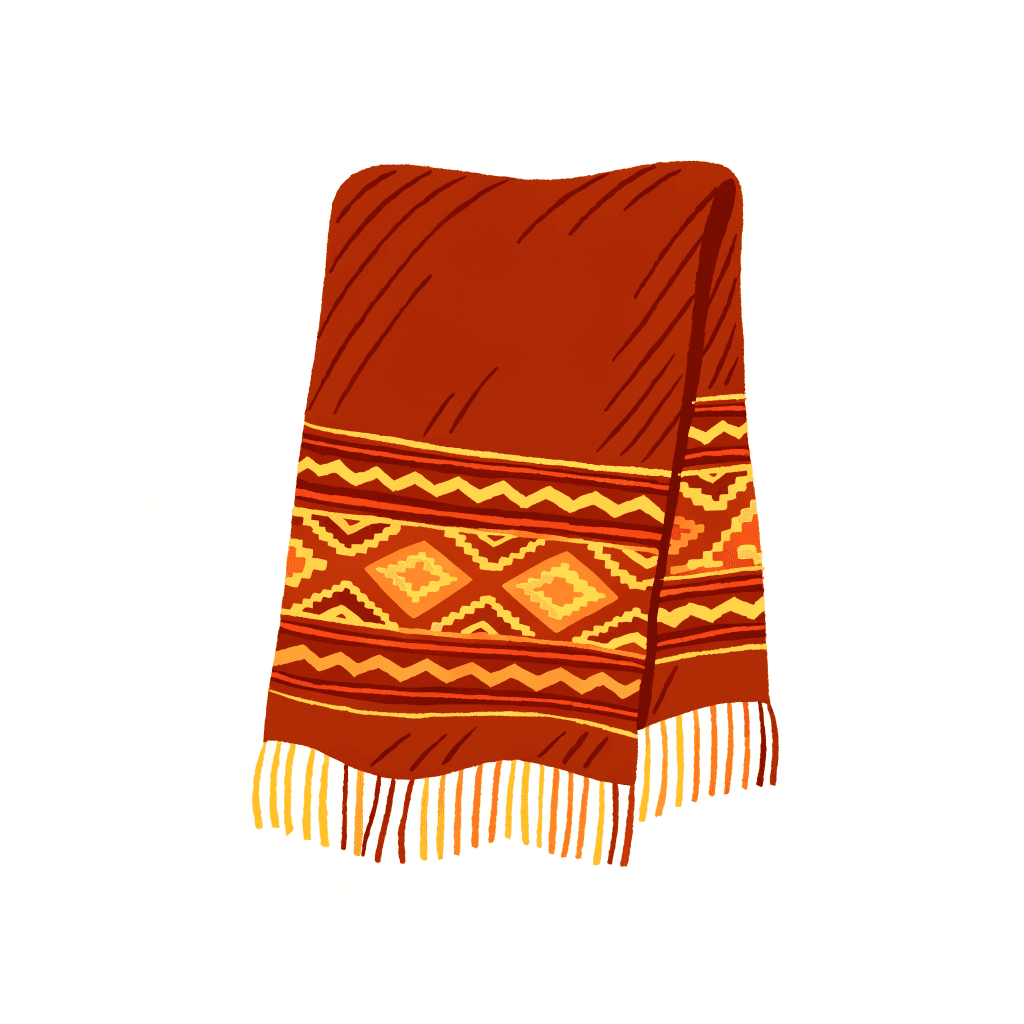
The Kullu valley has always woven for warmth. Long before shawls became souvenirs, Himachali hill families wove pattus — thick draped wraps of local sheep wool — on looms at home, plain cloth for a cold climate. The Kullu shawl as the world knows it took shape in the twentieth century, when patterned weaving traditions associated with Kinnaur and the old Bushahr region met the valley's looms and gave rise to its signature: bold geometric pattis, bands of diamonds, crosses and stepped lozenges in bright contrasting colours, run across the ends of an otherwise plain body. The craft scaled through cooperation. Weaver cooperatives formed in the valley from the 1940s onward organised what had been a household activity into a livelihood, and Kullu's bazaars became synonymous with the shawl. The palette is fearless — scarlet, saffron, emerald and black against the natural greys, whites and browns of undyed wool — but the grammar is strict: pattern lives in the borders, the body stays quiet. Warm, graphic and unpretentious, the Kullu shawl remains what it started as: the everyday wrap of the Himachali hills that happens to be beautiful.
How it is made
A Kullu shawl starts with wool — local sheep wool for everyday pieces, merino for softness, and angora or pashmina blends at the premium end. The body is woven plain or in natural undyed shades on frame looms. The patti borders are the skilled part: weavers interlock brightly dyed woollen wefts by hand, tapestry-fashion, to build the geometric bands — diamonds, chevrons, stepped crosses — that identify the craft. A shawl may carry anywhere from one narrow border to elaborate multi-band ends in five or more colours. Depending on fibre and pattern density, a piece takes from a couple of days to a few weeks on the loom.
Buying guide
Feel the borders: in a handwoven Kullu shawl the patterned pattis are slightly raised and the reverse shows neat interlocked colour joins, not long machine floats. Ask what the fibre is — local wool, merino, angora or pashmina blend — because that drives price more than pattern. Expect roughly ₹1,500–₹4,000 for standard wool shawls, ₹5,000–₹12,000 for merino and angora, and up to ₹25,000 for pashmina-blend pieces. Buy from weaver cooperatives in the valley or GI-tagged sellers.
Care
Treat it as fine wool: dry-clean, or hand-wash occasionally in cold water with a wool-specific detergent, without soaking or wringing. Dry flat away from direct sun. Store folded with cedar or neem against moths, in a breathable bag. A gentle brush-down keeps the surface fresh between seasons.
Good questions, honest answers
Are all Kullu shawls pure wool?
No — fibre varies widely and honestly drives the price. Everyday shawls use local sheep wool; softer pieces use merino; premium shawls blend in angora or pashmina. All can be genuine Kullu weaves. What matters is that the seller states the composition plainly and the borders are handwoven.
How do I tell handloom from powerloom?
Look at the back of the patterned border. Handwoven pattis show tidy, interlocked colour changes; powerloom versions leave long floating threads and feel flatter. Handloom cloth also has minor, pleasing irregularities in the weave. The GI tag and Handloom Mark settle any remaining doubt.
What do the geometric patterns mean?
The vocabulary — diamonds, crosses, stepped lozenges — is shared with the older weaving traditions of Kinnaur and the high Himalaya, where such motifs ornamented ceremonial wraps. In Kullu they function mostly as a visual signature rather than a fixed symbolic code: bold colour and geometry against a quiet woollen ground.
Explore the living traditions
We are onboarding Kullu Shawl artisans. Meanwhile, explore every craft available on VedikCraft today.
Explore all crafts →
At a glance
- Region
- Kullu, Himachal Pradesh
- Community
- Kullu weavers
- Materials
- wool, pashmina, angora
- Techniques
- geometric border weaving
- Typical price band
- ₹1,500 – ₹25,000