Paintings & Folk Art
Phad Painting — Rajasthan's Travelling Temple Scrolls
The story
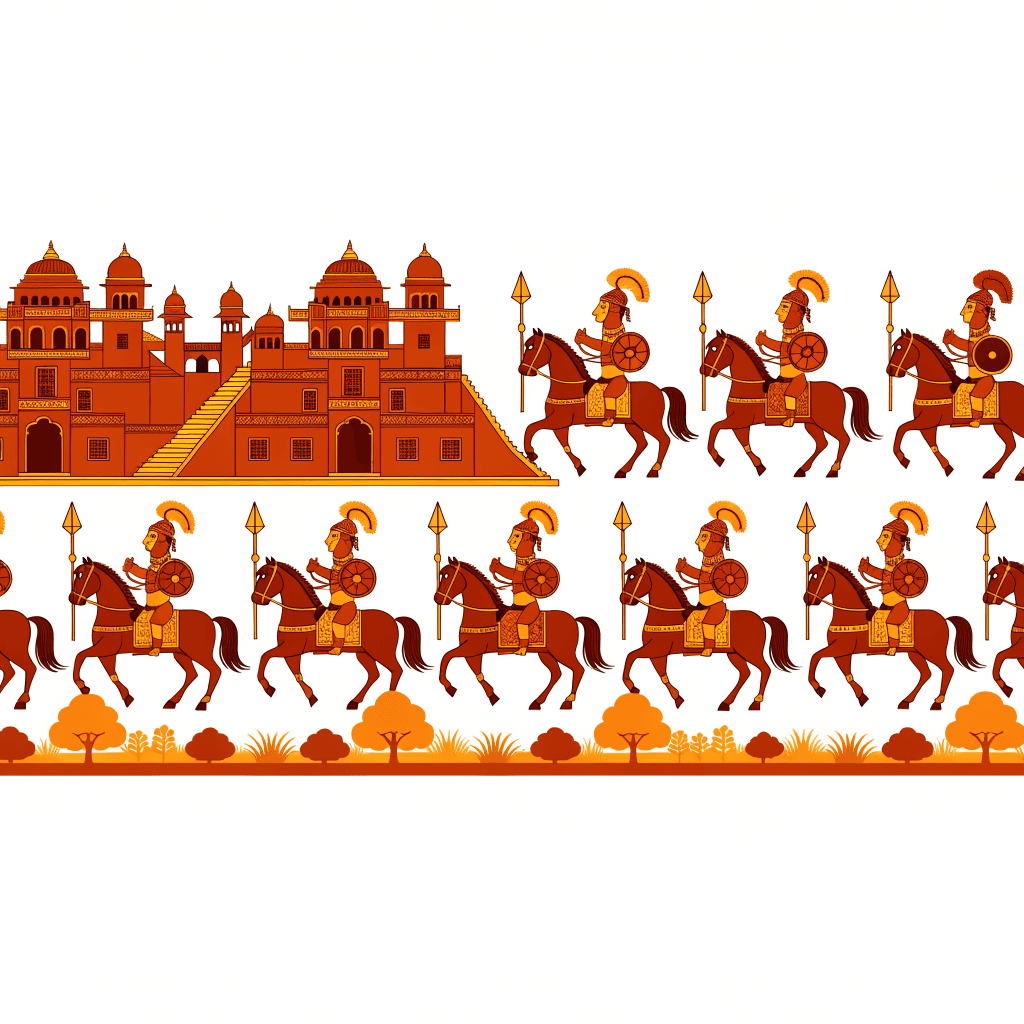
A phad is a painted epic: a long cloth scroll that carries the entire ballad of a Rajasthani folk deity — most famously Pabuji, the camel-herding protector hero, and Devnarayan, the divine warrior. For centuries the scrolls have been painted by the Joshi families of the Bhilwara–Shahpura region, and performed by Bhopas, hereditary priest-singers, who travel with the scroll as a portable temple. At night, before a gathered village, the Bhopa sings and bows his ravanhatta fiddle while his wife, the Bhopi, holds a lantern to the scene being sung — the phad is not read left to right but narrated episode by episode, wherever the story lives on the cloth. The conventions are strict: figures face one another rather than the viewer, a character's size reflects narrative importance, and the composition packs courts, battles and processions into every inch. A phad becomes sacred only when the hero's eyes are painted, and a worn-out scroll is not discarded but ritually cooled in sacred water. The tradition continues in Bhilwara today, in both full ceremonial scrolls and smaller formats made for homes and collectors.
How it is made
Phads are painted on coarse handloom cotton, starched with wheat- or rice-flour paste and burnished with a smooth stone until the surface tightens. The layout is set in a pale sketch that maps every episode of the ballad across the length of the cloth. Colour is then applied one hue at a time across the entire scroll — every orange in the story, then every yellow, green, brown and red — with black reserved for the final outlining. The pigments are earth and mineral colours bound in gum, dominated by the hot orange that gives phads their unmistakable warmth. Last of all, the painter opens the eyes of the hero — the stroke that, in tradition, turns a painting into a shrine.
Buying guide
A genuine phad shows the tradition's fingerprints: starched hand-loomed cloth, earthy mineral colour dominated by orange, figures facing each other rather than the viewer, and confident freehand black outlining. Full-length narrative scrolls are rare and priced accordingly; most market pieces are single-episode panels, which are entirely authentic when painted by Bhilwara's hereditary workshops. Expect roughly ₹2,500 for small panels, rising to ₹1,50,000 for large or complete story scrolls.
Care
Frame panels behind glass, away from sunlight and moisture — the starched cloth ground can warp in damp, and the natural pigments dislike UV. Large scrolls should be stored rolled loosely, painted side out, wrapped in cotton or acid-free paper, and unrolled a few times a year to prevent set creases.
Good questions, honest answers
Whose stories do phad paintings tell?
Chiefly two Rajasthani folk deities: Pabuji, the camel-riding protector hero of the desert, and Devnarayan, a warrior worshipped as a divine incarnation. Each has his own scroll tradition and ballad, sung across whole nights of performance. Modern phads also take on Ramayana and Mahabharata episodes and commissioned themes.
Why do the figures in a phad face each other?
Because a phad is a performance map, not a window. Characters turn toward whoever they address in the ballad, so the Bhopa can point to a scene and sing the dialogue between them. Size follows status too — the hero looms large while minor characters shrink, regardless of where they stand.
Is a phad painting religious or decorative?
Traditionally sacred: a scroll was consecrated the moment the hero's eyes were painted, served as a mobile temple through years of performances, and was ritually cooled in holy water when worn out. Contemporary panels made for homes are decorative — but they inherit the iconography and are painted with the same care.
Explore the living traditions
We are onboarding Phad Painting artisans. Meanwhile, explore every craft available on VedikCraft today.
Explore all crafts →
At a glance
- Region
- Bhilwara / Shahpura, Rajasthan
- Community
- Joshi painter families
- Materials
- cloth-scroll, natural-pigment
- Techniques
- narrative scroll painting
- Typical price band
- ₹2,500 – ₹1,50,000