Textiles & Handloom
Apatani and Adi Weaves of Arunachal Pradesh
The story
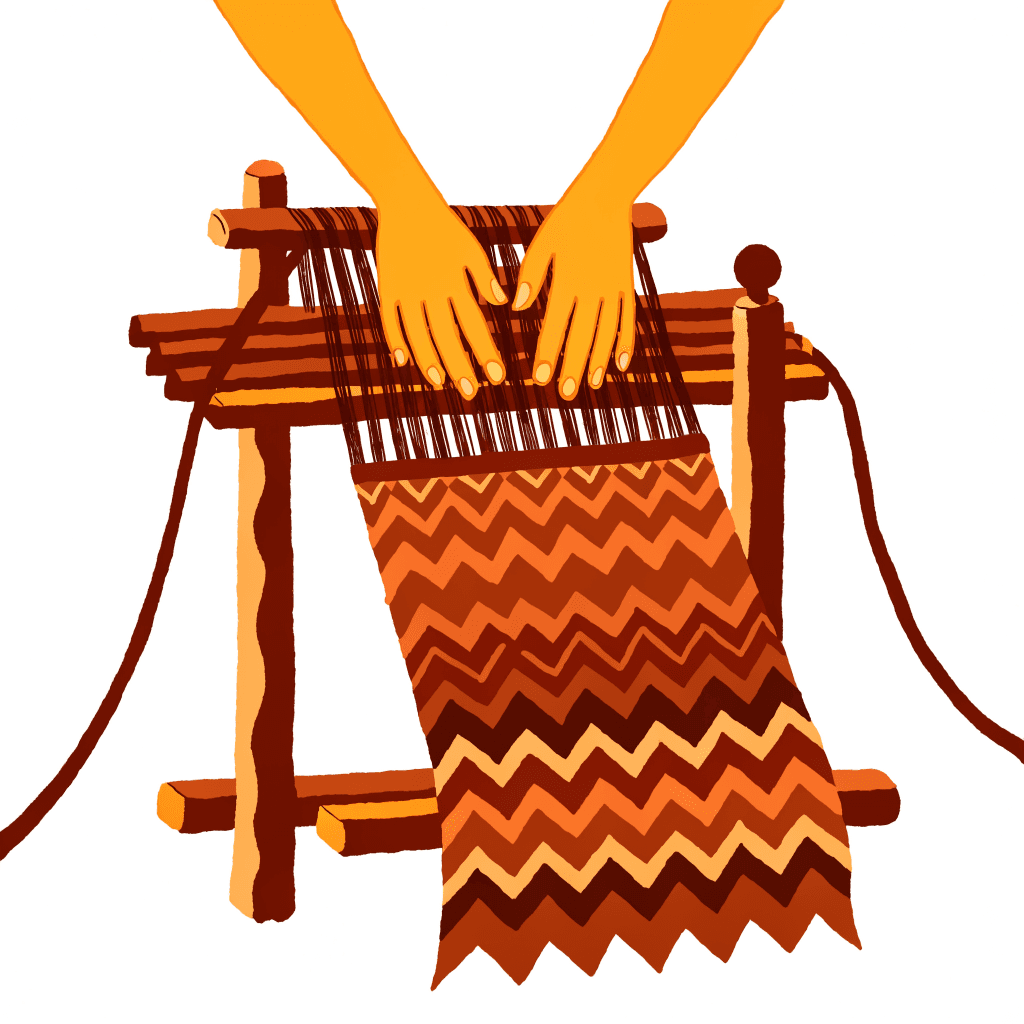
Arunachal Pradesh, India's easternmost state, is a mosaic of tribes, and nearly every one of them weaves. Among the best known are the Apatani of the Ziro valley — famed equally for their ingenious wet-rice-and-fish cultivation — and the Adi of the Siang river belt. Their loom is the loin loom, or backstrap loom: a portable arrangement of bamboo and rope in which the weaver's own body provides the tension, one strap around her lower back, the warp stretching to a post or veranda rail. On it, women weave narrow panels of remarkable precision — bands of black, red, white and yellow, zig-zags and lozenges ordered with an almost architectural discipline. The cloth is a social document: patterns and colourways signal clan, occasion and standing, and specific textiles belong to specific ceremonies, from festival dress to the wraps exchanged at life's milestones. The Adi gale, the women's wrap skirt, is one of the region's most recognisable garments. Weaving skill has long been part of a woman's standing in these communities, and though yarns are now often bought rather than home-spun, the loom, the motifs and their meanings remain firmly in tribal hands.
How it is made
Everything happens on the loin loom. The warp is wound as a continuous loop between bamboo beams, the far end lashed to a post and the near end held by a strap around the weaver's back — lean back and the warp goes taut, lean forward and it slackens for the next pick. Patterns are built two ways: bold warp stripes planned when the loom is dressed, and geometric motifs picked up by hand, the weaver lifting counted threads with a bamboo sliver to float coloured yarn across the ground. Because the loom limits width, garments are woven as panels and seamed together. Cotton is the everyday fibre; wool appears in heavier shawls and jackets for the mountain cold.
Buying guide
Simple cotton wraps start around ₹1,500; large, densely patterned shawls and jackets in wool can reach ₹18,000. Authentic loin-loom cloth is narrow — look for panels joined by hand seams, a firm warp-faced feel, and slight pattern variations no powerloom reproduces. Motifs should follow tribal convention rather than generic 'ethnic' prints. Buy from Arunachal-based cooperatives or sellers who can name the community — Apatani or Adi — behind the piece; that traceability is your best guarantee.
Care
Hand wash cold and separately the first few times, as saturated reds and blacks may release excess dye. Use mild detergent, no bleach, and never tumble dry. Dry flat in shade to keep the panels from distorting. Woollen pieces prefer airing over washing. Iron on low, and store folded with neem leaves or cedar against moths.
Good questions, honest answers
What is a loin loom?
A backstrap loom: the simplest and most portable loom in the world, with no frame at all. The warp stretches between a fixed point and a strap around the weaver's back, so her body controls the tension. It produces narrow, dense, warp-faced cloth — which is why Arunachal garments are made of panels stitched together.
How do Apatani and Adi textiles differ?
Both share the loin loom and a geometric vocabulary, but each tribe keeps its own conventions of palette and pattern. Apatani cloth tends toward a restrained order of stripes and small motifs; Adi weaving, including the well-known gale skirt, favours bold banded compositions. To a practised local eye, the cloth names its community at a glance.
Do these weaves have a GI tag?
Not currently — unlike some other Northeast textiles, Apatani and Adi weaves are not GI-registered. Authenticity therefore rests on provenance: buy through tribal cooperatives, state emporia or sellers who document the weaver's community and village. Hand-seamed panels, warp-faced density and correct tribal motifs are the practical tells.
Explore the living traditions
We are onboarding Arunachal Handloom (Apatani / Adi) artisans. Meanwhile, explore every craft available on VedikCraft today.
Explore all crafts →
At a glance
- Region
- Ziro / Apatani valley, Arunachal Pradesh
- Community
- Apatani & Adi tribes
- Materials
- cotton, wool
- Techniques
- loin-loom geometric weaving
- Typical price band
- ₹1,500 – ₹18,000