Textiles & Handloom
Sanganer and Bagru: Jaipur's Block Print Twins
The story
Half an hour from Jaipur in either direction sit two towns that between them define Rajasthani block printing. Sanganer built its name on fine floral butis — delicate sprigs of poppy, rose and marigold stamped in soft reds and pinks on bright white grounds. Its printed calicoes were prized trade goods by the eighteenth century, travelling to markets far beyond India. Bagru, the earthier twin, is the home of dabu: a mud-resist technique that yields cream and black patterns on deep indigo and dyed grounds, alongside its classic syahi-begar palette of black and ochre. Both towns are worked by the Chhipa community, hereditary printers whose very name derives from chhapna, 'to print'. Workshops are family units: block carvers, printers, dyers and washers each holding one link of the chain. Water shaped both settlements — printers put down roots where rivers and wells suited the endless washing and dyeing of cloth. Together the two towns supplied everything from temple cloth to royal wardrobes, and today they anchor Jaipur's standing as a world capital of hand block printing. Sanganer's whites and Bagru's indigos remain the twin poles every lover of Rajasthani print learns to tell apart.
How it is made
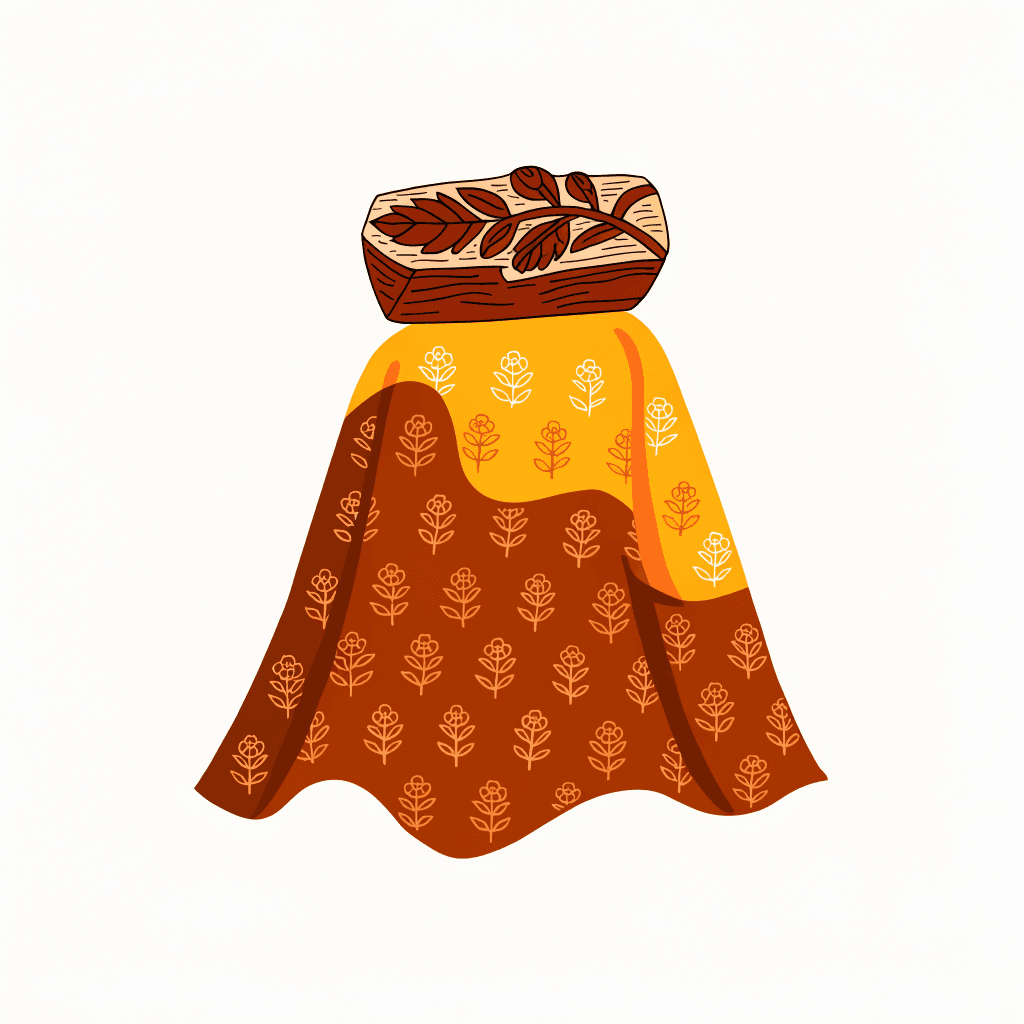
Everything starts with the block: teak, seasoned and hand-carved with the pattern in relief, one block per colour. A design typically needs a gad block for the background, a rekh for the fine outline and datta blocks for fillers, stamped in sequence with a practised thump of the fist. Sanganeri work prints dye and pigment colour directly onto washed white cotton, registration judged entirely by eye. Bagru adds the dabu stage: a resist paste of clay, lime, gum and wheat chaff is printed on, dusted with sawdust and dried, so that when the cloth is dipped in indigo the covered areas stay reserved. Repeated resist-and-dye rounds build layered depth before the final wash and sun-drying on open grounds.
Buying guide
Hand-stamped cloth reveals itself at the joins: look for slight breaks or overlaps where one block impression meets the next, and small pressure variations across a repeat. Screen prints are perfectly seamless and suspiciously flawless. On Bagru dabu, expect fine crackle lines where dye seeped through the mud resist — a hallmark, not a fault. Fabric, linens and garments typically range from about ₹600 for a metre of printed cotton to ₹15,000 for fine natural-dyed pieces and apparel.
Care
A cold or lukewarm gentle wash with mild detergent suits most pieces; wash indigo-dyed dabu separately at first, as it can release a little blue. Skip bleach and harsh spin cycles. Dry in shade — Rajasthani prints are sun-born but sun-faded — and iron on medium. These are working cottons: made to be worn, washed and worn again.
Good questions, honest answers
What is the difference between Sanganeri and Bagru prints?
Sanganeri prints are fine, multicoloured florals — small butis and flowering jaals — on a bright white or pale ground. Bagru works darker: its dabu mud-resist gives cream patterns on indigo, and its classic palette runs to black and ochre on beige. Both are hand-stamped with teak blocks by Chhipa printers, but the grounds and dye processes differ completely.
What is dabu printing?
Dabu is Bagru's mud-resist technique. A paste of local clay, lime, gum and wheat chaff is block-printed onto cloth and dusted with sawdust so it holds. When the cloth is dyed — typically in indigo — the pasted areas resist the colour, emerging pale once the mud is washed away. Multiple resist-and-dye rounds create layered, softly crackled patterns.
How can I spot a screen-printed imitation?
Study the repeat. Hand-blocked cloth shows tiny misalignments, ink-pressure changes and visible joins between impressions; a screen print repeats with mechanical perfection. Check the reverse too — hand printing with dyes usually penetrates the cloth more unevenly than flat screen pigment. Finally, very low prices on 'Sanganeri' fabric usually signal factory screen printing rather than teak blocks.
Explore the living traditions
We are onboarding Sanganeri & Bagru Block Print artisans. Meanwhile, explore every craft available on VedikCraft today.
Explore all crafts →
At a glance
- Region
- Sanganer & Bagru, Jaipur, Rajasthan
- Community
- Chhipa printers
- Materials
- cotton, natural & pigment dye
- Techniques
- hand block printing, dabu mud-resist (Bagru)
- Typical price band
- ₹600 – ₹15,000