Why Brass Turns Black or Green, and How to Fix Each
Brass turns brown or black from air and oil, and green from moisture, salt and acids. What each colour means, whether it matters, and how to clean it.
Brass turns brown or black because the copper in it reacts with air, smoke and oil, and it turns green when moisture meets salt, sweat or acid on the surface. Both are normal for real brass and both clean off. The colour tells you the cause, and the cause tells you the fix.
Short answer: real brass tarnishes; it is not a defect
Brass is an alloy of copper and zinc. Copper is a reactive metal, so any bare brass surface changes colour with time. A darkened diya or a spotted lota has not gone bad and is not fake. If anything, tarnish is a sign the piece is real brass. Plated iron behaves differently: it rusts red where the coating breaks.
| Colour | What it is | Usual cause | Fix |
|---|---|---|---|
| Brown to black | Copper oxide and sulphide | Air, smoke, oil, handling | Lemon and salt, tamarind, Pitambari |
| Green or blue-green | Verdigris, a copper compound | Moisture with salt, sweat or acidic food | Short vinegar or lemon soak, scrub, rinse, dry |
| Red rust | Iron oxide | The piece is plated iron, not brass | Not a brass problem |
Why it goes brown and black
Air alone slowly darkens brass to a warm brown. Smoke and oil push it further, to black. That is why mandir pieces darken faster than a showpiece in the drawing room: incense, camphor and ghee smoke all carry sulphur, and sulphur blackens copper. Skin oils do the same, which is why handles and edges darken first.
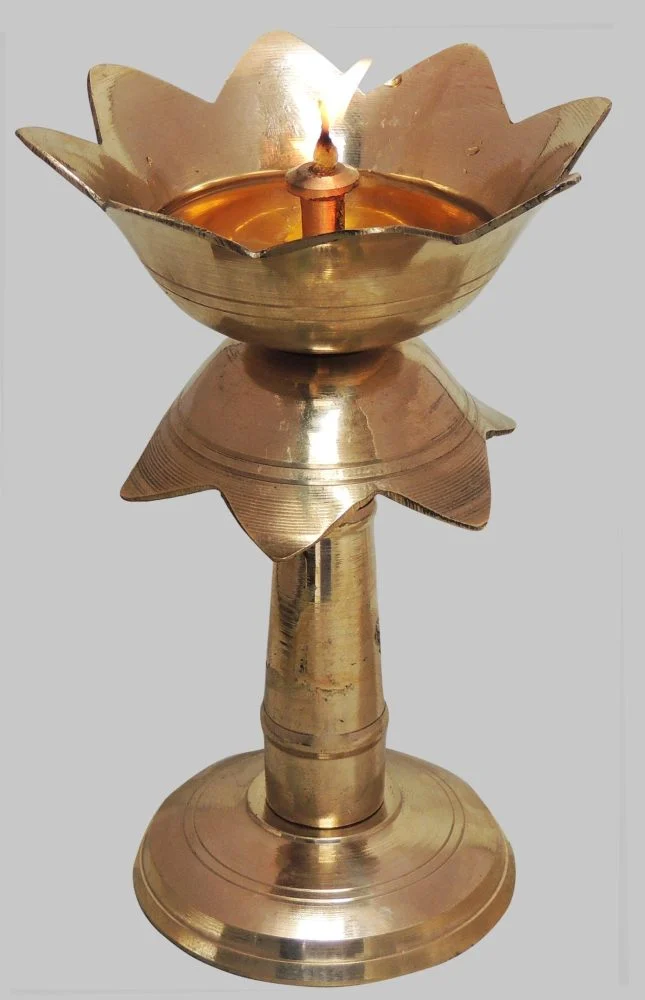
Diyas are the hardest case. Burnt oil bakes onto the cup, and mustard oil leaves a dark, sticky residue. Much of the black on a used diya is oil, not tarnish, and it needs hot water before any acid. An akhand diya that burns all night shows it most.
Why it goes green
Green needs water. When moisture sits on brass along with salt, sweat or acid, the copper forms verdigris, a green or blue-green crust. The common causes at home:
- Brass rinsed after lemon or tamarind and left to dry on its own.
- Water left standing in a lota or kalash for days.
- Sour or salty food left in a brass vessel.
- Storage in a damp cupboard or a plastic bag that traps moisture.
Is it harmful? Idols and decor versus food vessels
On idols, bells, lamps and decor, tarnish is a matter of looks only. Clean it or leave it, as you prefer.
Food and water vessels are different. Verdigris should be cleaned off completely before a vessel is used for food or water. Do not eat or drink from a brass vessel that shows green inside. Brown tarnish on the outside of a vessel is not a concern. For what can and cannot be cooked in brass, see is brass safe for cooking.
Fixing black: lemon and salt, tamarind, pitambari
These methods are for raw brass only. Lacquered brass is wiped with a dry cloth and never treated with acid.
- Lemon and salt for plain surfaces. Dip a cut lemon in salt, rub in circles, rinse, dry.
- Tamarind pulp for engraved pieces and heavy tarnish. Rub on with fingers or a soft cloth, rinse, dry.
- Pitambari for a quick all-over shine on utensils and plain pieces.
For diyas, deal with the oil first: hot water and dish liquid, a soft brush in the cup, then lemon and salt for the shine. Dry at once. The full method by item is in how to clean brass before Diwali.
Fixing green: vinegar or lemon soak, scrub, rinse, dry
- Wet the green area with vinegar or lemon juice and leave it for a few minutes. Do not leave brass soaking for hours.
- Scrub with a soft brush or cloth. For stubborn spots, a paste of vinegar, flour and salt helps.
- Rinse until no trace of green or paste remains, inside and out.
- Dry with a cloth immediately, then air dry.
Prevention: dry storage, lacquer, a wipe after use
- Dry every piece fully after washing or puja.
- Wipe after use so oil and fingerprints do not sit on the metal.
- Store in cloth on a dry shelf, not in plastic.
- For decor, choose lacquered pieces. The clear coat keeps air off the brass. See lacquered vs raw brass.
- A thin rub of coconut or mustard oil on raw brass slows the next tarnish.
Hindi readers can follow the same routine in पीतल के बर्तन और मूर्ति कैसे साफ करें. Our brass diyas are listed with their material and finish.