How Many Diyas to Light on Diwali, and Where to Put Them
13, 21 or 51? What the tradition says about the number of diyas on Diwali, where each one goes, which oil to use, and how to keep the akhand diya burning all night.
Ask five families and you get five numbers. The short answer: an odd number, and at least 13, with one diya that never goes out. Here is where the numbers come from and where each diya goes.
The numbers people use
| Count | Why |
|---|---|
| 1 | The Yama deepam on Dhanteras, facing south outside the door. Not part of the Diwali count. |
| 5 | The minimum many elders quote: mandir, main door, kitchen, water place, tulsi. |
| 13 | The most common Diwali count in North India. Thirteen is the number of the tithi cycle from Dhanteras (Trayodashi) and is the figure most puja guides print. |
| 21 | For a larger house or a shop plus a home. |
| 51 or 101 | For big houses, temples, and shop fronts. The number is a scale, not a rule. |
Where the 13 go
- In front of Lakshmi and Ganesh: the akhand diya, lit first, ghee, burns all night.
- Main door, right side as you enter (left for the one who comes in).
- Main door, left side.
- Kitchen, near the stove or the grain store.
- Water place: the tank, the filter, or the washing area.
- Tulsi plant.
- Bathroom or the house’s corner that stays dark. The old instruction is to light the darkest spot in the home.
- Under the peepal or outside the gate if there is one; otherwise the staircase.
- Balcony or terrace.
- Each window sill, the remaining four.
Shops add a diya at the counter and one at the cash box after the Chopda puja.
Which oil in which diya
- Ghee in the mandir diyas and the akhand diya. Burns clean, no smell, no black residue on brass.
- Mustard oil for the outdoor and door diyas. Traditional, cheap, burns well in wind, but it blackens the rim, so use it in clay or in brass diyas you will clean the next day.
- Sunflower or sesame oil for the indoor sills. Less residue than mustard.
- Never wax candles inside a brass diya. The wax bonds to the metal.
Keeping the akhand diya burning all night
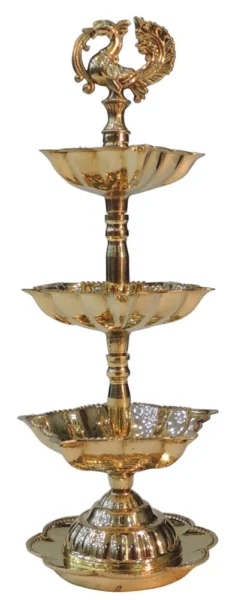
- Use a brass diya with a deep cup of 100 ml or more. The small tortoise diyas are for an hour; a Kuber deepak or a stand diya with a 2 inch deep cup holds enough ghee for six to eight hours.
- Use a thick twisted cotton wick, about a finger long, with 1 cm above the ghee. A long wick burns fast and smokes.
- Keep it out of the draught and put a glass chimney over it if the window is open.
- Top up the ghee before you sleep. Melt it first so it does not smother the flame.
Brass versus clay
Clay diyas are for the sills and the rail: cheap, disposable, and the right thing to leave outside. The mandir diya, the akhand diya, the two at the door and the Kuber deepak are the ones that come out every year, and those are where brass earns its price. A cast brass diya sits flat, does not soak oil, and polishes back to new with lemon and salt. The weight is the tell: a 3 inch brass diya should be 60 g or more; under that it is sheet.