Kalai Explained: Why Brass Cookware Is Tin Coated
Kalai is a thin tin lining inside brass and copper cookware. Why sour food needs it, how to cook and clean on it, and how to spot kalai that has worn off.
Kalai is a thin layer of tin on the inside of brass and copper cookware. It is there because sour and salty food reacts with bare brass, and tin stands between the two. If you cook curries in a brass kadhai, the kalai matters; when yellow metal shows through the silvery lining, it is time to re-tin.
What kalai is
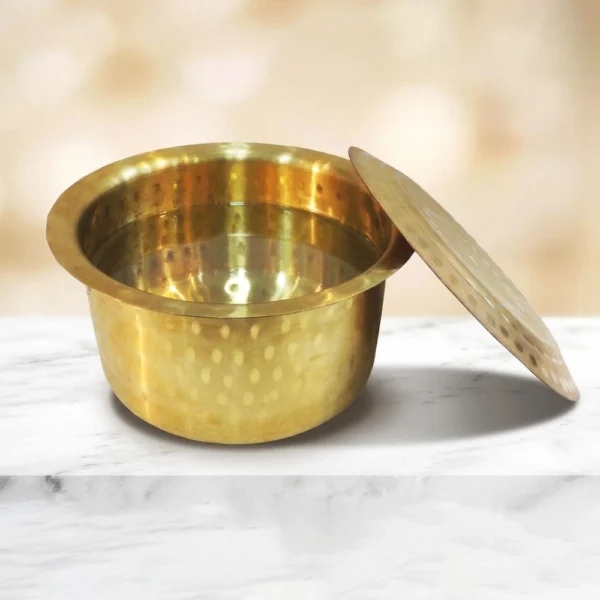
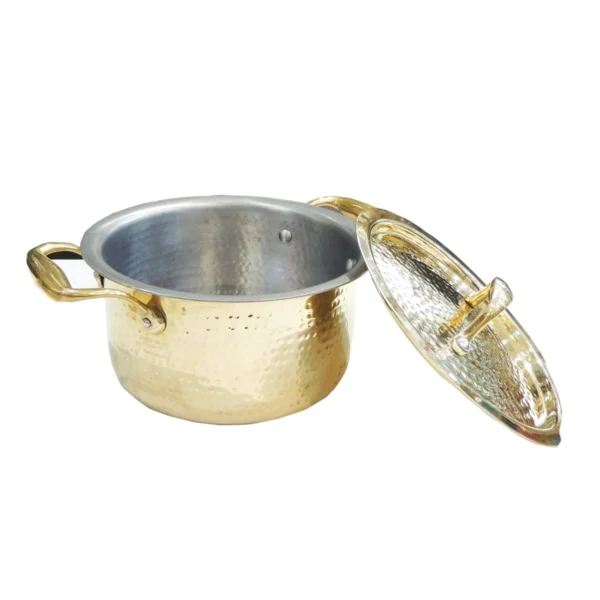
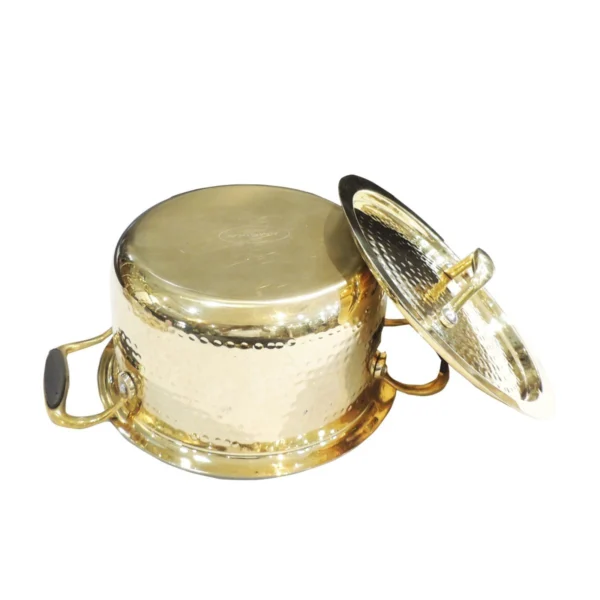
Kalai, also written kalhai, is tinning done by hand. The kalai wala heats the vessel, cleans the inside, and wipes molten tin across the hot surface with a pad of cotton. The tin bonds to the brass and leaves a bright, silvery lining. The outside of the vessel stays yellow brass.
A fresh lining is mirror bright. With use it turns a soft matt grey. That is normal and does not mean it has worn out.
Why brass and copper need it for sour and salty food
Brass is copper and zinc. Acids in food, such as those in tomato, tamarind, lemon, curd and vinegar, react with unlined brass. Salt does the same, more slowly. The food picks up a metallic, bitter taste and the vessel can develop green spots. Tin does not react with these foods in ordinary cooking, so a tin lining is the traditional barrier. Copper vessels are lined for the same reason.
What you can cook without kalai, and what you should not
| Fine in unlined brass | Needs intact kalai |
|---|---|
| Deep frying puri, pakora, mathri | Curries with tomato |
| Boiling water or milk | Sambar, rasam, anything with tamarind |
| Dry roasting | Kadhi and other curd dishes |
| Plain rice | Dishes finished with lemon, amchur or vinegar |
With or without kalai, do not store cooked food in a brass vessel. Move it to steel or glass once the meal is over. More on this in is brass safe for cooking.
Cooking on kalai: never heat empty, wooden spoon
Tin melts at about 232°C. A vessel with oil or food in it stays below that in normal cooking. An empty kadhai on a full flame does not. So the rules are short.
- Never heat a kalai vessel empty. Add oil, water or food first, then light the flame.
- Use a wooden or silicone spoon. A steel karchhi scrapes the lining off stroke by stroke.
- Keep the flame medium. Brass is thick and holds heat well. It does not need a high flame.
- Do not let a dish cook dry. A scorched patch can blister the tin.
Cleaning without scrubbing the tin away
Tin is soft. Most kalai is lost at the sink, not on the stove.
- Soak stuck food in warm water first, then wash with a soft sponge and dish soap.
- No steel wool, no wire scrubber and no abrasive powder on the inside.
- No lemon, tamarind or Pitambari on the inside. Those are for the brass, not the tin.
- Clean the yellow outside like any raw brass: lemon and salt or Pitambari, rinse, dry at once.
- Dry the vessel fully before putting it away.
The Hindi cleaning guide, पीतल के बर्तन कैसे साफ करें, covers the outside of a kadhai in more detail.
When and where to get re-tinning done
Kalai wears with use and scrubbing. How long it lasts depends on how often you cook in the vessel and how you wash it, so there is no fixed schedule. Go by what you see. When yellow brass shows through the silvery lining, at the base or along the line where the spoon runs, stop cooking sour and salty food in it and get it re-tinned.
Kalai walas still work in the old utensil markets of most towns, and many do the rounds of neighbourhoods before Diwali. Shops that sell brass and copper vessels usually know one. The work is done while you wait or within the day, and the same vessel can be re-tinned again and again.
Our cookware range has 67 pieces, 54 of them in pure brass. The Brass Kadhai with Kalai (Tin Coated) comes in 1, 1.75, 2.5, 3 and 3.5 litre sizes, priced from ₹2,015 to ₹4,890; see the brass kadai collection. A kadhai is also a traditional utensil purchase on Dhanteras, covered in what to buy on Dhanteras and the Dhanteras gifts collection.